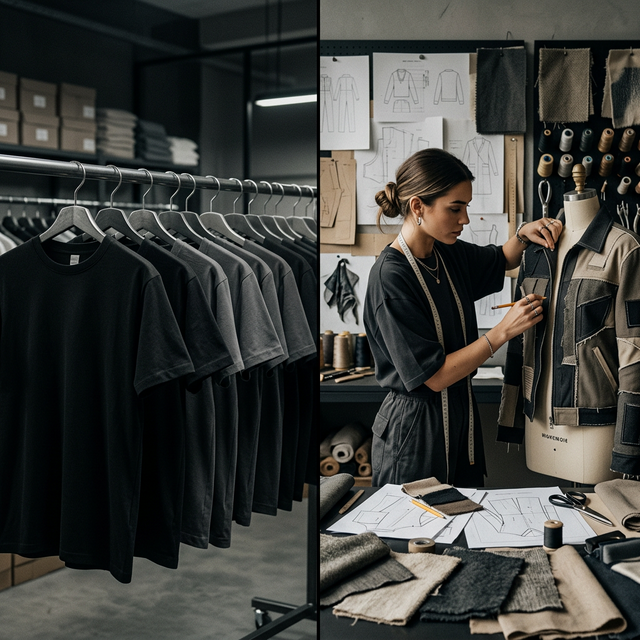
Private Label vs.
Custom Manufacturing
Are you just printing on blanks, or are you building lasting brand equity? Let's break down which approach actually fits your vision.
Krazy Kreators Team
March 12, 2026
Launching a new fashion collection? You're likely facing the first pivotal crossroad of your brand's future: do you buy high-quality generic blanks and slap your logo on them (Private Label/White Label), or do you design everything from scratch, building a unique garment from the yarn up (Custom Manufacturing)?
There's no single "correct" answer, but making the wrong choice for your specific business model has killed countless promising fashion startups. Are you aiming to be a fast-moving merch brand, or a premium streetwear label with silhouettes that customers actively seek out?
In this breakdown, we'll dissect exactly what each method entails, their pros and cons, and why deeper-pocketed clients almost always pivot to custom-cut-and-sew to secure long-term brand equity.
1. The Private Label / White Label Approach
Private Labeling (often called White Labeling in other industries) is the practice of purchasing pre-manufactured, blank garments produced by a factory, and then having them "re-labeled" with your brand's neck tag. You then apply your custom prints, embroidery, or wash treatments to these blanks.
The Pros
- Low Barrier to Entry: Minimum order quantities (MOQs) are virtually non-existent. You can print on just 20 hoodies if you want to.
- Speed to Market: Because the garments already exist in a warehouse, you skip the prototyping and fabric-sourcing phases. You can turn an idea around in weeks.
- Predictable Fit: If you use a famous blank brand, customers generally know how exactly that specific shirt will fit them.
The Cons
- Zero Unique Identity: Your $80 t-shirt is fundamentally the exact same construction and fabric as a local gym's $20 merch t-shirt. The only difference is the graphic.
- High Margin Ceiling: Blank providers take their own profit margins. When you attempt to scale, the "per-unit" cost of a high-end blank remains stubbornly high, crushing your wholesale viability.
- Vulnerable Supply Chain: If the blank manufacturer discontinues your favorite silhouette or colorway, your flagship product is instantly dead.
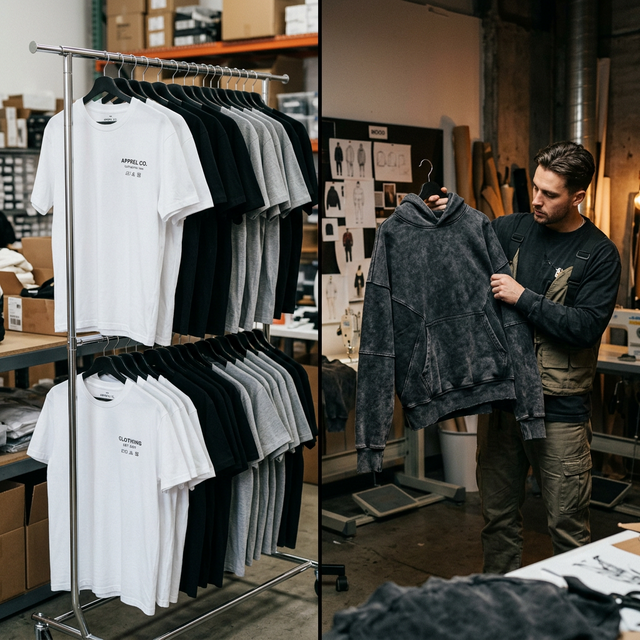
The difference is visual: generic blank vs a truly proprietary silhouette.
Who is it for? Content creators moving into basic merch, small dropshippers, or cash-strapped startups wanting to test a simple graphic concept without betting the farm.
2. Custom Cut & Sew Manufacturing
Custom manufacturing is how true fashion brands are built. You design the exact measurements. You choose the specific 350 GSM French Terry cotton. You dictate the exact drop-shoulder angle and the specific ribbing density on the collar. The factory sources raw fabric, cuts it to your proprietary patterns, and sews it specifically for your brand.
The Pros
- Proprietary Silhouette: When someone asks, "Wow, where did you get that hoodie? The fit is amazing!" they can only buy it from you. Your fit becomes your moat.
- Significantly Better Margins at Scale: Since you aren't paying a middleman for their blank profit margins, your unit cost drops dramatically as you produce higher volumes.
- Limitless Execution: Custom hardware, unique wash treatments (like acid or enzyme washes), complex paneling, and engineered print placements are only possible through cut & sew.
The Cons
- Higher Investment: Factories have to dye raw fabrics and cut proprietary patterns, so MOQs apply (typically 100-300 units minimum per style).
- Longer Development Time: It takes time to iterate on technical Tech Packs, create fit samples, adjust patterns, and greenlight bulk production.
- Requires Expertise: You need a basic understanding of fabrics, grading, and Tech Packs (unless you partner with a full-service manufacturer like Krazy Kreators).
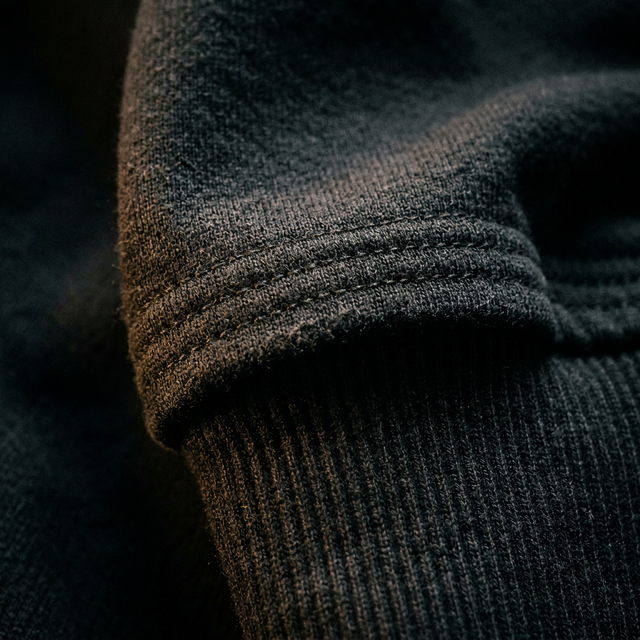
Custom manufacturing allows you to dictate every detail, down to the gauge of the stitching and the density of the ribbing.
Who is it for? Serial entrepreneurs, established brands, and serious designers who view their business as a long-term fashion house, not a short-term graphic t-shirt hustle.
3. Why Real Brand Equity Demands Custom Manufacturing
If you want to charge $100+ for a hoodie, your customer must feel the value. In 2026, consumers are hyper-educated. A teenager can spot a standard print-on-demand blank from a mile away.
When you rely on private label blanks, your entire brand's value is placed strictly on your logo or graphic. If a competitor produces a cooler graphic on the exact same blank, they steal your customer.
But when you invest in Custom Manufacturing, you create physical value. The hefty weight of the cotton, the precise crop of the jacket, the unique dye pattern—these elements create brand loyalty that graphics alone cannot replicate. Cult brands like Represent, Cole Buxton, and Corteiz aren't printing on generic blanks; they've defined the market by pioneering completely custom, proprietary silhouettes.
The Krazy Kreators Advantage
We built our entire supply chain to help ambitious brands bridge the gap between "private label" and "high-end fashion house."
- Accessible MOQs: While traditional custom factories demand 500+ units, we support emerging brands with lower MOQs to make cut & sew viable.
- Free Tech Packs: Making the jump to custom requires technical design. We create your Tech Packs in-house for free.
- End-to-End Control: From spinning specific yarn weights to executing complex acid washes, your garments become impossible for cheap competitors to copy.
The Verdict
Private printing on generic blanks is an excellent way to figure out if you actually want to run a clothing business. But the moment you are serious about building a brand that survives seasons, defines trends, and commands premium pricing, pivoting to custom manufacturing is non-negotiable.
Ready to graduate to Cut & Sew?
Stop relying on standard blanks. Build a brand that is physically distinct. Book a clarity call with us and let's discuss engineering your next custom collection.
Did you find this comparison helpful?
Discussion (0)
Leave a Reply
No comments yet. Be the first to share your thoughts!