
Ask three factories what a custom cotton tee costs. You will get three numbers that look nothing alike. None of them is lying.
They are quoting different things. One is pricing the sewing only. One is pricing sewing plus fabric. One is pricing everything up to a packed box at the port — and quietly assuming an order size you never agreed to.
So the useful question is not “what does it cost.” It is what is in this number, and what lands on me later? Custom clothing manufacturing cost comes down to five parts, plus a few more you pay after the goods leave the factory. Here is each one, priced at four order sizes. Every figure below is a worked example — swap in your own numbers and it still works.
What the price is actually made of

Custom manufacturing means the garment is built to your pattern and your spec. It is not pulled off a factory’s existing block. Know that difference before you compare two quotes, because it is usually why the numbers sit so far apart. We covered the trade-off in detail in private label vs. custom manufacturing.
Almost every custom garment price is five lines. Fabric. Trims. Cut-make. Finishing. And the factory’s own running costs and profit. On a plain 180 GSM cotton crew tee at 1,000 units, a typical split looks like this:
| Cost line | What it covers | Per unit |
|---|---|---|
| Fabric | Knitted, dyed and finished cloth, plus cutting waste | $2.95 |
| Trims | Neck label, care label, thread, hangtag, polybag | $0.55 |
| Cut-make | Cutting, sewing labor, machine time | $2.20 |
| Finishing & QC | Pressing, thread-trim, inspection, folding, packing | $0.45 |
| Overhead & margin | Factory floor cost, admin, the factory’s profit | $1.35 |
| FOB price (free on board — goods loaded at the origin port) | $8.50 | |
Two things stand out. Fabric is the biggest single line, about a third of the price. And the quote stops at the port. Everything between that port and your warehouse is still yours to pay.
“The useful question isn’t what it costs. It’s which lines are in this number, and which ones land on me later.”
Cost per garment at every MOQ tier
MOQ (minimum order quantity — the smallest run a factory will take) is the first thing most founders try to change. It does move the price. Just not for the reason people think. Price drops with quantity because the fixed costs get shared out, not because the sewing gets faster.

Here is the same tee at four order sizes. Treat these as ranges, not a price list. Your own quote will move with the fabric, how the garment is built, any printing, and where it is made.
| Tier | FOB per unit | What you are really buying |
|---|---|---|
| 50–150 Test run | $14–22 | Proof that the garment sells. Fabric is bought at or near dye-lot minimums, so you pay a surcharge or over-buy cloth. |
| 300–500 First real drop | $9–13 | A full size run with enough of each size to actually sell. The first tier where a normal dye lot works for you rather than against you. |
| 1,000–2,500 Repeat program | $6.50–9 | Real unit economics. Setup and paperwork costs stop skewing the price, and the factory can plan its line around you. |
| 5,000+ Volume | $5–7 | Fabric straight from the mill and a line of your own. Past this point the savings flatten out — most of the drop has already happened. |
Notice where the curve bends. Going from 150 to 500 units roughly halves the price per tee. Going from 1,000 to 5,000 saves about $2.50. The first jump changes the business. The second only tunes it. That shape matters when you are deciding how big a bet to place on your first order.
The cost that doesn’t scale
Before a factory sews a single sellable unit, someone has to turn your idea into instructions a machine operator can follow. That work is billed separately. It happens once per style. And it is the line most first-time founders forget to budget for.
| One-time development | Why it exists | Typical range |
|---|---|---|
| Tech pack | The spec document a factory quotes and builds from | $150–600 |
| Pattern + grading | The base pattern, then scaling it across your size run | $100–350 |
| Samples × 3 rounds | Proto, fit, then the sealed pre-production sample | $200–450 |
| Lab dips & strike-offs | Color and print approvals before bulk dyeing starts | $50–160 |
| Development per style, before a single unit exists | $500–1,500 | |
Call it $900 for a simple style. That $900 is the same whether you make 100 pieces or 5,000. This is where the real MOQ math lives.
Infographic 01
The same $900 of development, spread four ways
One-time cost per style — tech pack, patterns, grading, three sample rounds, lab dips — divided by the number of units it is shared across.
A thin tech pack is the most expensive way to save $400. Every unclear detail turns into another sample round, and each extra round costs money and about ten to fourteen days. Two rounds you could have avoided cost more than the document you skipped — which is the argument we made in what a tech pack actually is.
Why fabric beats volume
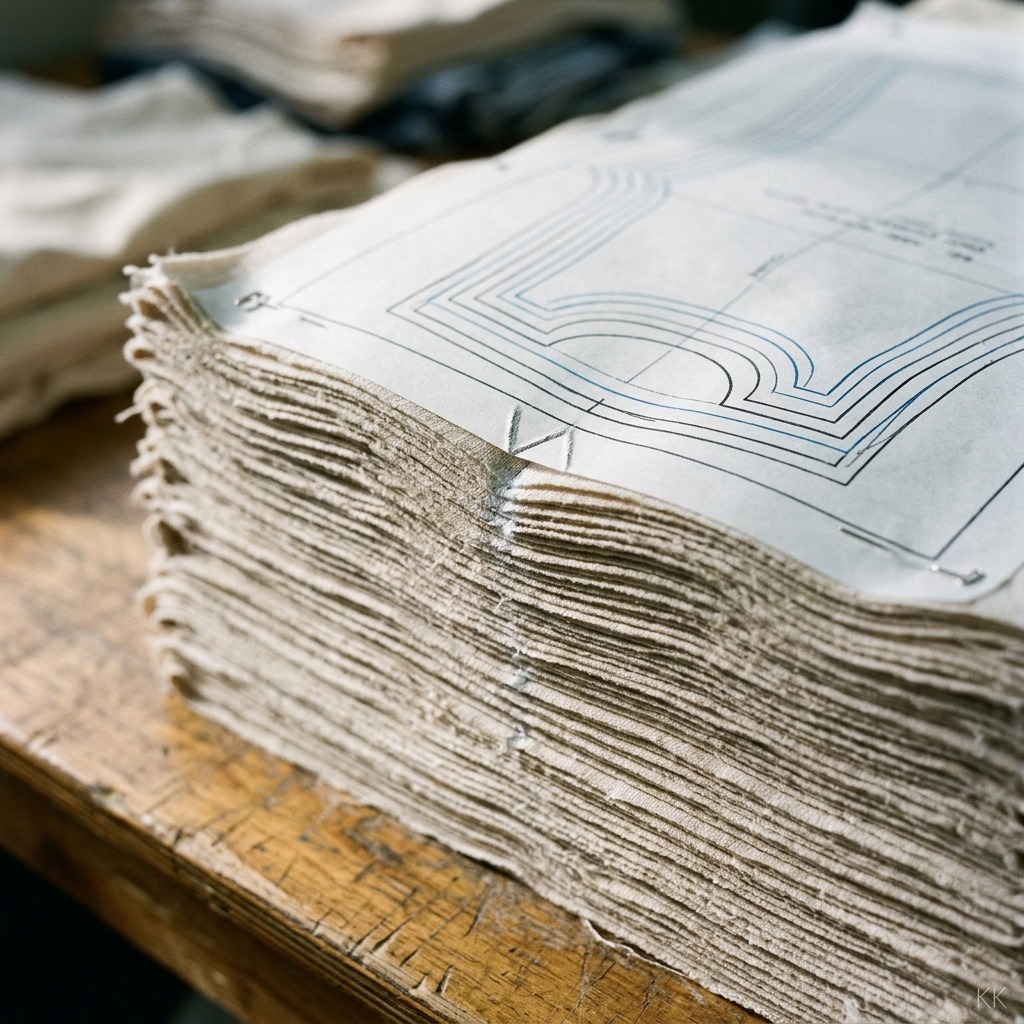
Fabric is sold by weight, so two things set this line: what the cloth costs per kilo, and how many kilos your garment uses. GSM (grams per square metre — how heavy the cloth is) decides the second one. A heavier tee uses the same area of cloth; that cloth just weighs more.
Raw cotton sets the floor under all of it. The Cotlook A Index, the standard world benchmark for raw cotton, sat at 93.00 US cents per pound on 5 August 2026. Knitting, dyeing and finishing multiply that several times over before the cloth reaches a cutting table. So ask for the finished-fabric price, not the raw cotton price.
Here is the same tee body in three cloths, at the same 1,000-unit run:
| Fabric | Cost / kg | kg / tee | Fabric cost | Change |
|---|---|---|---|---|
| 180 GSM combed cotton jersey | $7.00 | 0.42 | $2.94 | baseline |
| 220 GSM heavyweight cotton | $7.50 | 0.51 | $3.83 | +$0.89 |
| 240 GSM certified organic knit | $11.00 | 0.56 | $6.16 | +$3.22 |
Read those last two columns together. Upgrading the cloth adds $3.22 a unit. Going from 1,000 units to 5,000 saves about $2.50. So the fabric choice matters more than the order size — and it is the one you usually make in an afternoon, on feel.
That is not an argument for cheap cloth. Better fabric is often exactly what a brand should be selling. Customers can see it and feel it, and it justifies a higher price far better than a logo does. It is an argument for choosing on purpose, with the number in front of you. Which weights suit which garments is laid out in our guide to GSM and fabric weight.
“Upgrading the cloth costs more than quintupling the order saves. Customers can feel one of those decisions.”
Free download
The Garment Cost Sheet
A blank version of every table on this page — five cost lines, four MOQ tiers, the development spreader and the landed-cost stack. Enter your own fabric price and quantity; it fills in the rest. Spreadsheet + PDF.
The lines the quote leaves out
An FOB quote ends at the port where your goods get loaded. Between there and your warehouse sit four more costs. All four are published, so you can look every one of them up before you sign anything.
Freight. Sea freight is priced by the container, so it only becomes a per-unit number after you divide. Drewry’s World Container Index put the global composite at $4,297 per 40ft container on 6 August 2026. Spread across roughly 12,000 tees, that is about 36 cents a unit before drayage and terminal charges — call it $0.60 all-in. Air freight costs many times more — you pick it to save time, not money.
Duty. This is the big one, and it is fixed by what the garment is made of, not who made it. A cotton knit tee falls under HTS 6109.10.00 at a 16.5% general rate. The same tee in a man-made fiber pays roughly double. Change the fiber and you change the duty. Most brands make that costing decision by accident. Additional trade actions can stack on top of that base rate, and they move — we tracked the current regime in the July 24 tariff cliff.
Federal fees and brokerage. Small, fixed, and easy to forget. For fiscal 2026 the merchandise processing fee is 0.3464% of value, with a $33.58 floor and a $651.50 ceiling per formal entry. That floor is the detail that bites. On a small shipment you pay $33.58 either way — spread over 200 units that is 17 cents a garment, but over 2,000 units it is under two cents. Ocean shipments add a 0.125% harbor maintenance fee, and a customs broker charges a flat fee per entry.
Infographic 02
One tee, quoted at $8.50, landed at $11.59
A 180 GSM cotton crew tee on a 1,000-unit run, shipped by sea and cleared into the US.
- Factory price (FOB)$8.50
- Ocean freight + drayage$0.60
- US duty @ 16.5%$1.40
- MPF + HMF$0.04
- Customs brokerage$0.15
- Development, spread out$0.90
- Landed cost per unit$11.59
The whole point of that chart is the gap. Quoted at $8.50, landed at $11.59 — the factory price is 73% of the real number. Set your retail price off $8.50 and you have built your whole margin on three-quarters of your cost.
If you want to sanity-check any of this against reality, the Commerce Department’s Office of Textiles and Apparel publishes US apparel import data by country and category, including average unit values. It is the closest thing to a public benchmark for what garments actually cross the border at.
How to read a quote in five minutes
A single number in an email is not a quote. It is a starting point. These five questions turn it into something you can actually compare — and a factory that answers all five straight has told you a lot about how it works.
Is this FOB, EXW or landed?
EXW means the goods sit at the factory door and every step after is yours. FOB means loaded at the origin port. Landed means delivered, duty paid. Comparing an EXW price to a landed price is not a comparison.
What fabric price and consumption is this built on?
Ask for cost per kilo and estimated kilos per garment. If the two quotes differ and the fabric line explains the gap, you are not looking at two prices — you are looking at two different garments.
How many sample rounds are included?
Three is normal — proto, fit, pre-production. Find out what the fourth costs, because you will probably want it.
What quantity is this price valid at, and what is the tolerance?
Every quote assumes a quantity. Most also allow a shipping tolerance — usually a few percent over or under — and you are billed for what actually ships. Get both numbers before you plan your stock.
What happens if bulk fails inspection?
The most expensive line on any quote is the one nobody wrote down. Ask who pays for rework, who inspects, and at what stage. Get the answer before the deposit, not after.
The cheapest quote in a set of three is often the one with the most missing lines. It gets expensive later, in rework, in a fourth sample round nobody budgeted, in a shipment that arrives after the season — the failure modes we catalogued in the real cost of choosing the wrong manufacturer. A higher quote that includes three sample rounds and inline inspection can be the cheaper number by the time goods land.
When the bigger run is the wrong call

Everything above points one way: bigger runs are cheaper per unit. That is true. It is also the most reliable way for a new brand to lose money.
Run the total, not the unit. Five thousand tees at $6.18 all-in is $30,900 of inventory. Five hundred at $12.80 is $6,400. The 5,000-unit price is less than half per garment — and if you sell 400 pieces, the cheap decision left you sitting on roughly $28,000 of cotton in a storage unit, while the expensive one left you with a sell-out, a waiting list, and cash to reorder.
Cost per unit is the right thing to chase once you know the product sells. Before that, the number that matters is how much cash is at risk. The smallest run that gets you a garment you would put your name on is usually the right order. The expensive per-unit price is buying you information, and information is cheaper than a warehouse.
What we’d do in your shoes
Build the cost sheet before you ask for a quote, not after. Write down your fabric, your target GSM, your size run and your quantity, then add the four costs that come after the port. You will get better quotes, because a factory can tell from one email whether you know what you are asking for.
Then price your first order for information, not for margin. What is the smallest run that gets you a garment you would stand behind, and what does it land at with every cost counted? If you can answer that with one number, you are ahead of most brands that have already launched.
Common questions
How much does it cost to manufacture custom clothing?
For a mid-weight cotton crew tee, factory (FOB) quotes typically run about $14–22 per unit at 50–150 units, $9–13 at 300–500, $6.50–9 at 1,000–2,500, and $5–7 at 5,000 and above. Those are per-unit production prices only. Add one-time development — tech pack, patterns, grading, samples, lab dips — of roughly $500–1,500 per style, plus freight, duty and customs fees on the way in.
Why is the cost per garment higher at low MOQ?
Two reasons. Fixed costs — pattern making, marker planning, machine setup, a dye lot minimum, one customs entry — are the same whether you make 100 units or 5,000, so each unit carries a bigger share. And mills price fabric in minimum dye-lot quantities, so a small order often pays a surcharge or buys more cloth than it uses.
What drives clothing manufacturing cost the most?
Fabric, usually. On a basic tee, fabric is commonly the single largest line in the factory price. Moving from a 180 GSM combed cotton jersey to a 240 GSM certified-organic knit can add more per unit than quintupling your order quantity saves.
What does a clothing manufacturing quote leave out?
Most quotes are FOB — the goods loaded at the origin port. They usually exclude ocean or air freight, drayage, US duty (16.5% on cotton knit tees under HTS 6109.10.00), the merchandise processing and harbor maintenance fees, customs brokerage, and the development cost you already spent getting to a sealed sample.
Is a low MOQ clothing manufacturer cheaper overall?
Cheaper in total outlay, more expensive per unit — and that is usually the right trade before demand is proven. A 5,000-unit run at $6.18 all-in is $30,900 of inventory. If you sell 400 units, the cheap per-unit price was the expensive decision.
Read next
7 min read
What Is a Tech Pack?
The document that decides how many sample rounds you pay for.
8 min read
Private Label vs. Custom Manufacturing
Two routes to a first order, and what each one really costs you.
8 min read
The Real Cost of the Wrong Manufacturer
Wrong samples, defective bulk, nobody to call — priced out.
Comments
No comments yet
Be the first to share your thoughts!