
The deals are gone. The number they created is not.
Prime Day 2026 ran June 23–26 — four days, Prime-exclusive, with fashion marked up to 40% off (About Amazon). That was three weeks ago. The revenue line looked great on June 26.
The margin line is the one landing right now — in your July settlement, after the refunds clear, the fulfillment fees post, and the ad spend that chased the spike gets counted. This is the part nobody screenshots for the founder group chat.
The event ends. The settlement doesn't

A discount is instant. Its cost is not. You gave up margin dollars in a weekend; you'll spend a quarter finding out how many.
The marketplace discount cycle — Prime Day, then Labor Day, then the Black Friday run, then a “New Year” clearance — trains two things at once. It trains inventory to move. It also trains your customer to wait, which quietly repriced every full-price week between the events.
Contribution margin (what's left from a sale after the variable cost of making and delivering that unit) is the number that actually pays your rent. Public DTC apparel brands run a median gross margin around 55–57% (Eightx, SEC 10-K data) — and still go underwater at the contribution line once the discount and the fulfillment stack eat the rest.
“The revenue spike is a number you feel on the day. The margin cost is a number you read a quarter later — and by then the next discount window is already open.”
The make-vs-discount math founders skip
Here's the math that gets skipped, because it's uncomfortable and it isn't on the sales dashboard. Take a $50 tee at a 40% gross margin — $30 to make and land, $20 of margin. Watch what each discount tier does to the units you now have to sell just to keep the same profit dollars (Phoenix Strategy Group).
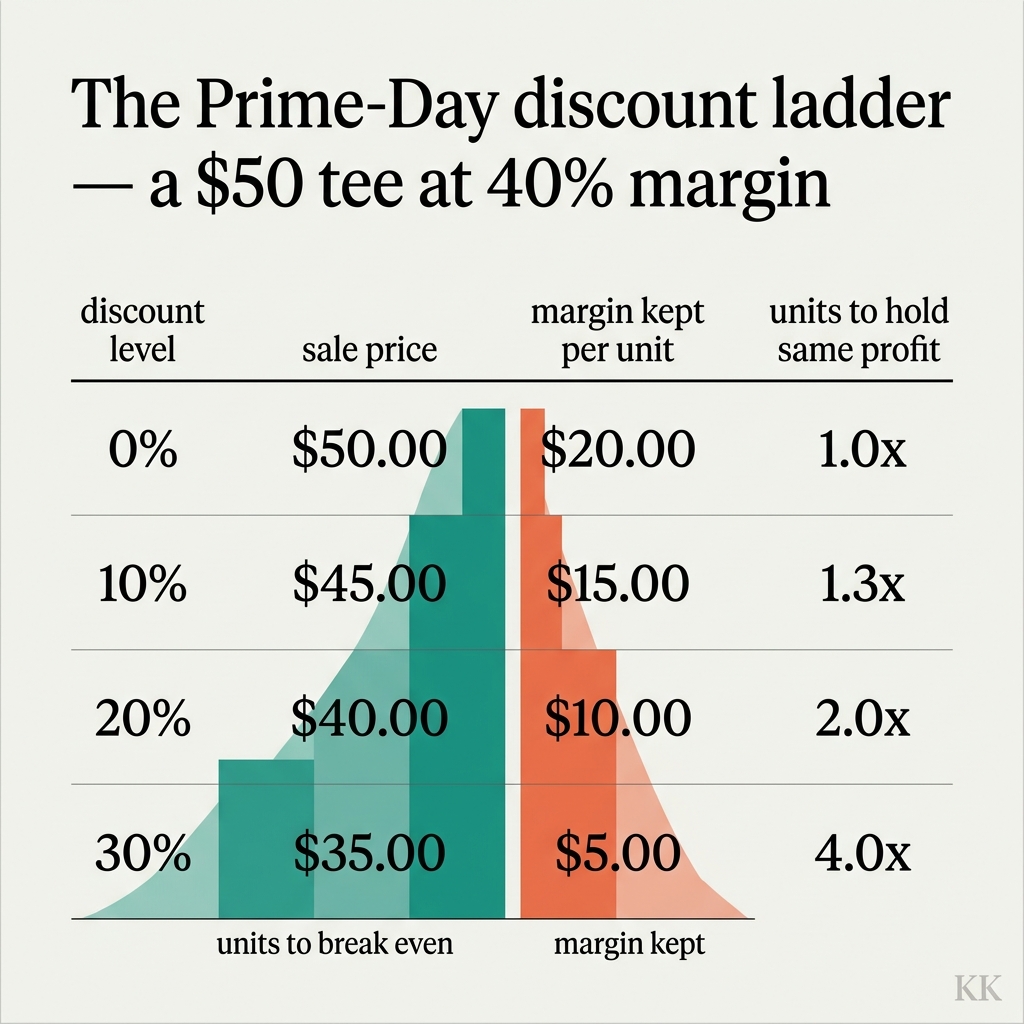
| Discount | Sale price | Margin kept / unit | Units to hold profit |
|---|---|---|---|
| 0% | $50.00 | $20.00 | 1.0× |
| 10% | $45.00 | $15.00 | 1.3× |
| 20% | $40.00 | $10.00 | 2.0× |
| 30% | $35.00 | $5.00 | 4.0× |
A 30% cut doesn't cost you 30%. It quarters your margin per unit, so you need four times the volume to stand still. Prime Day gives you a volume bump — rarely a 4× one. The gap is your loss, and it posts in July.
“A 30% discount doesn't cost 30%. It quarters your per-unit margin — and the marketplace fee comes out of what's left.”
The marketplace tax nobody re-priced
If any of that volume ran through Amazon, a second layer came out before you saw a cent. Apparel referral fees are tiered — roughly 5% under $15, 10% from $15–$20, and about 17% above $20 (EcomCalc), and they're frozen at those levels through 2026.
Fulfillment moved, though. As of April 17, 2026, Amazon added a 3.5% surcharge on all US FBA fulfillment fees, on top of a January fee revision (Amazon Selling Partners). Most founders re-priced their retail for the discount and never re-priced for the fee. On that same $50 tee, ~17% referral plus fulfillment plus the discount can leave a contribution margin you'd never have greenlit on paper.
Free download
The Make-vs-Discount Margin Sheet
Drop in your sale price, landed cost, marketplace fee and return rate. It shows your real contribution margin per unit — and the break-even volume for any discount depth. PDF.
Why “just move units” is the trap
The instinct after a soft margin report is to run another promo and make it up on volume. In apparel, three forces make that the most expensive instinct you have.
- Returns. Apparel returns run 25–40% of gross sales, and a 30% return rate can raise your realized customer acquisition cost by around 43% on the customers who keep the product (Luca). A discount-driven buyer returns more, not less.
- Repeat rate. Apparel has the lowest repeat-purchase rate in DTC — under 10% (Eightx). A discount buyer rarely comes back at full price to fix the economics.
- CAC. Apparel customer acquisition costs sit near $90 (Eightx). Spend that to acquire a one-time, deep-discount, high-return buyer and the unit was underwater before it shipped.
The counterexample — when the discount is the right call. Sometimes it is. Clearing end-of-life inventory, funding a genuine first-order acquisition play with a real repeat engine behind it, or avoiding a carrying cost that exceeds the margin you'd give up — those make a deep cut the disciplined move, not the desperate one. Markdown optimization (right depth, right timing) is shown to lift margin rate by 4–8 points versus reflexive, across-the-board cuts (Onebeat). The problem is never discounting. It's discounting without the math.
Signs your Prime Day was a margin loss, not a win
- • Revenue set a record but July contribution margin fell versus a normal week.
- • Return rate on discounted orders is running above your full-price baseline.
- • You needed the next promo to move the inventory the last promo left behind.
- • Your retail price was re-set for the discount but never for the 2026 marketplace fees.
Building margin back in — before the next drop
Here's the lever the discount conversation skips entirely: the make side. A discount subtracts margin per unit and trains the customer to wait. A lower landed cost adds margin per unit — at full price, at every price, on every future drop, with no behavior to un-train. They point in opposite directions.
Shave that $50 tee's landed cost from $30 to $27 — through better fabric sourcing, a tighter tech pack, smarter trims, consolidated production — and you've added $3 of margin per unit at full price. That's more durable profit than a 15%-off weekend delivers, and the customer never learns to hold out for it. It's the difference between the real cost of the wrong clothing manufacturer and a make partner who builds margin headroom in at the tech-pack stage.
Do it before the sample is approved, not after the settlement lands. And read it alongside the two costs already moving underneath you: the July 24 tariff cliff and the August landed-cost rebuild. Margin you design in survives the discount cycle. Margin you discount away doesn't come back.
The move for your next drop

Prime Day is a volume event wearing a growth costume. The founders who win the next one aren't the ones who discount deeper — they're the ones who walked in with enough margin headroom that a promotion is a choice, not a rescue.
So before the Labor Day window opens: which of your top sellers could carry a 40% marketplace discount and still clear contribution margin — and which ones can't, no matter how many units move? If you can't answer that per SKU, that's the sheet to run this week. What would you do — cut the discount, or fix the make?
The bottom line
Prime Day didn't grow your margin — it borrowed against it, and the July settlement is the bill. A brand still reading the revenue spike as the result is measuring the wrong number.
Cost every SKU on contribution margin, know its break-even volume before you set a discount depth, and put the real work into the make — because $3 of landed cost taken out at the tech pack beats a discount weekend on every drop that follows. Do that and the next event is a lever you pull on purpose, not a hole you spend a quarter climbing out of.
FAQs
When was Prime Day 2026, and why does the margin hit land in July?
Prime Day 2026 ran June 23–26 (About Amazon). The revenue posts on the day, but refunds, fulfillment fees and ad spend settle over the following weeks — so the true DTC profit margin shows up in the July report, not on the sales dashboard.
How much extra volume does a Prime Day discount need to break even?
On a 40%-gross-margin item, a 10% discount needs about 1.3× the units to hold the same profit dollars, a 20% discount needs 2×, and a 30% discount needs 4× (Phoenix Strategy Group). Most events don't deliver a 4× volume lift — the gap is your margin loss.
What are Amazon's 2026 apparel fees?
Apparel referral fees are tiered — about 5% under $15, 10% from $15–$20, and ~17% above $20 (EcomCalc) — and frozen through 2026. FBA fulfillment carries a 3.5% surcharge added April 17, 2026 (Amazon Selling Partners).
Is discounting always bad for margin?
No. Clearing end-of-life stock, funding a real acquisition play with a repeat engine behind it, or avoiding carrying costs can justify a deep cut. Markdown optimization lifts margin rate 4–8 points over reflexive cuts (Onebeat). The issue is discounting without the break-even math.
What is the “make-vs-discount” math?
A discount subtracts margin per unit and trains customers to wait. Lowering landed cost adds margin per unit at full price — permanently, on every drop. Shaving $3 off a $30 landed cost beats a 15%-off weekend and costs you no future full-price sales.
How do I know if my Prime Day was actually a loss?
Compare July's contribution margin to a normal full-price week, check whether discounted orders returned above baseline, and confirm your retail was re-priced for 2026 marketplace fees — not just for the promo.
Read next
8 min read
Every Parcel Pays Now: The End of the $800 Rule
What the end of de-minimis does to your per-unit cost.
9 min read
After the Cliff: Rebuild Your Cost Sheet for August
Three duty scenarios and the real August landed cost of a $14 tee.
7 min read
The Real Cost of the Wrong Clothing Manufacturer
Where margin quietly leaks between sketch and shelf.
Comments
No comments yet
Be the first to share your thoughts!