The cliff everyone spent June bracing for had an anticlimax built into it: nothing on your cost sheet actually changed the moment it passed.
Section 122's flat 10% surcharge hit its 150-day statutory limit on July 24, 2026 and lapsed — the President can't renew it alone (Congressional Research Service). What comes next is a duty assessed the day your goods clear US customs, which for a Fall program is sometime in August — not the day you signed the PO in May.
So the sheet you built at 26.5% is now a guess about a number that gets fixed at the dock. This is the rebuild — line by line, across all three outcomes still on the table.
The date passed. Your cost sheet didn't

Three outcomes are live for goods clearing in August, and your cost sheet has to hold up under each. The first: the blanket lapses with nothing behind it, and duty falls to the MFN rate alone (most-favored-nation — the WTO baseline every member's goods pay), about 16.5% on a cotton knit tee (Tariffs Tool).
The second and third are USTR's Section 301 forced-labor duties (a trade action sorting suppliers by whether they ban forced-labor imports). The proposal sets +10% for the 14 economies that prohibit such imports — Bangladesh, Cambodia, Pakistan, Indonesia, Mexico — and +12.5% for the 46 that don't, a group that includes China, India and Vietnam (White & Case).
We mapped the full country-by-country stack in the breakdown of the 10% floor and what replaces it. The point here is narrower: your August number is no longer a rate you know. It's a range you have to plan around.
“For a few months the blanket made every sourcing country cost the same. August is where that flat line fractures back into a spread — sorted by policy, not price.”
Duty follows the entry date, not the PO
Here's the mechanic that trips up most cost sheets: US Customs assesses duty at the rate in force on the date of entry (when the goods are released into US commerce) — not the day you ordered, and not the day the container left the origin port. Goods that clear in August pay August's regime.
That's why the 10% you locked into a spring PO tells you almost nothing about what you'll actually owe. The June re-costing exercise — done before the cliff, while the blanket still applied — protected the order. This one protects the clearance.
One real exception is worth pricing in. If your goods originate in Mexico and qualify under USMCA yarn-forward rules, the 16.5% MFN line can fall to zero — though how the new Section 301 duty interacts with USMCA origin is still unsettled, so confirm it with your broker before you bank the saving.
Signs your cost sheet is still living in July
- • The duty line still reads a flat 10%, carried over from the spring PO.
- • Landed cost is pegged to order date, not projected clearance date.
- • There's one duty figure on the sheet, not a low-mid-high range.
- • Nobody has asked the broker which regime an August entry will hit.
The $14 tee's August landed cost, three ways
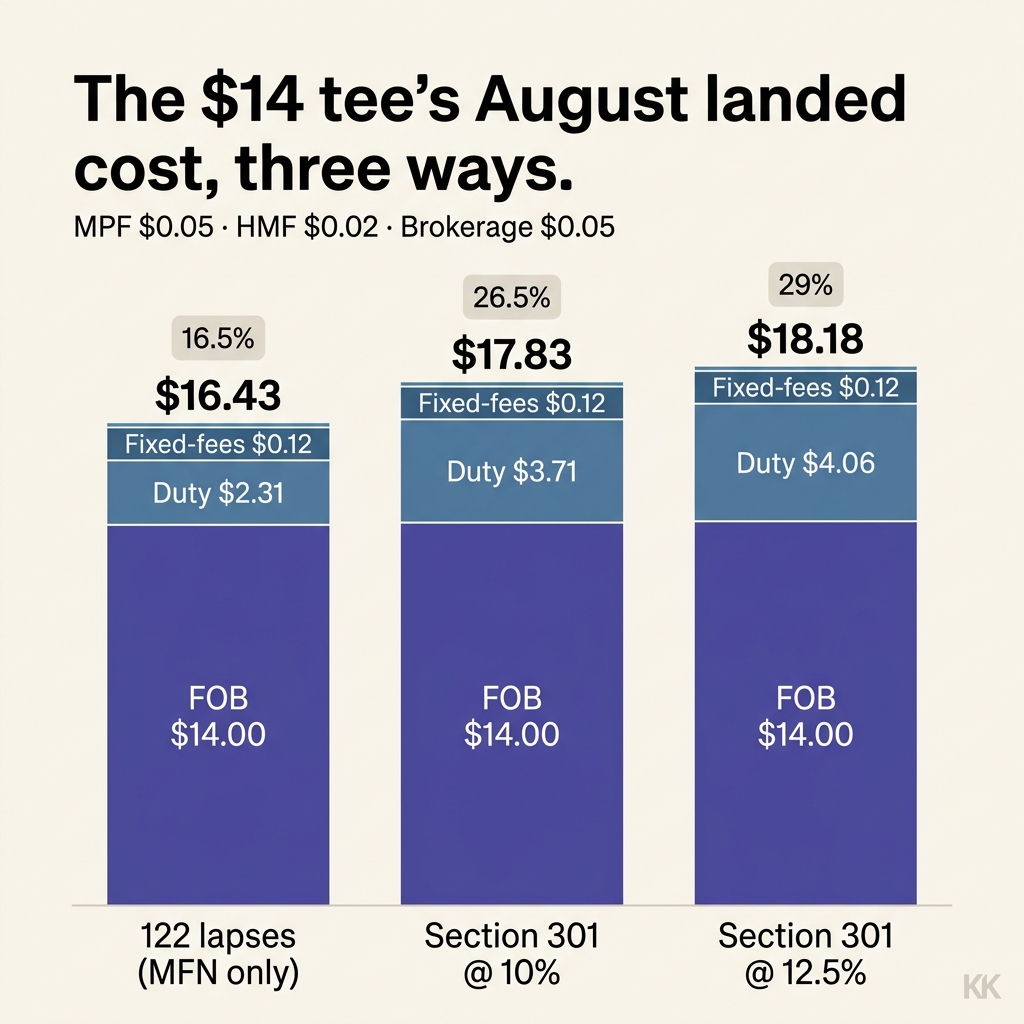
Put a real garment through it: a blank cotton knit tee at $14 FOB (free on board — the supplier's price at the origin port, before freight and duty), on a 5,000-unit run cleared as one consolidated ocean entry. Duty is assessed on that customs value.
The duty line, three ways:
- Blanket lapses (MFN only): 16.5% = $2.31/tee
- Section 301 at 10% (Bangladesh, Cambodia): 16.5% + 10% = 26.5% = $3.71/tee
- Section 301 at 12.5% (India, Vietnam): 16.5% + 12.5% = 29% = $4.06/tee
- China adds its legacy 7.5% List 4A duty on top: 36.5% = $5.11/tee
Set China aside and the swing across the three mainstream outcomes is $1.75 a tee — about $8,750 of unknown on that 5,000-piece run. That's the number your Fall margin has to be able to absorb, not the single figure sitting on the sheet today.
“Cost at the low number and a mid-outcome eats your margin. Cost at the high number and a lapse hands it back. Only one of those mistakes is recoverable.”
Free download
The August Landed-Cost Rebuild Worksheet
One page that runs any FOB price and quantity across all three post-July scenarios — duty, MPF, HMF and brokerage baked in — and flags the margin gap between the low and high outcome. PDF.
The fees that don't care who wins in court
While everyone watches the duty line, three smaller charges sit underneath it and don't move with the tariff fight at all. They're the reason a rebuilt sheet has to be landed cost, not FOB plus a duty guess.

- The Merchandise Processing Fee (MPF) — 0.3464% of customs value on a formal entry, floored at $33.58 and capped at $651.50 for FY2026 (US Customs and Border Protection).
- The Harbor Maintenance Fee (HMF) — 0.125% of value on ocean shipments, same source.
- Customs brokerage — roughly $150–$400 per formal entry in 2026 (Greenwich Mercantile).
On our 5,000-unit consolidated entry that's about $0.05 MPF, $0.02 HMF and $0.05 brokerage per tee — roughly $0.12 a unit. Trivial at that scale, which is exactly the tell: these are near-fixed per entry, so they punish fragmentation, not volume.
Split that same run into small direct shipments and the brokerage alone can outrun the duty — the math that broke the ship-direct model when the $800 de minimis exemption ended. Consolidation is the one landed-cost lever the court docket can't touch.
Rebuild the sheet in four lines
You don't need to predict which outcome lands. You need a sheet that stays solvent under any of them.
One — cost on landed, not FOB. Roll duty, MPF, HMF, brokerage and freight into the unit number, so the figure you price against is the one that clears customs. Two — use the clearance-date scenario. Cost against the regime your August entry will actually hit; if it's still unresolved, cost at the worst credible case (12.5%) and treat a lapse to 16.5% as recovered margin, not a surprise.
Three — consolidate entries. One bulk import into a US 3PL beats fragmented parcels on every fixed fee, and it's the move a split-origin sourcing plan should be built around. Four — name who eats the delta. A tariff pass-through clause between order and clearance decides, in advance, whether you or the factory absorbs a mid-shipment change — so a ruling in August doesn't become a renegotiation.
One nuance can lower the ceiling: the Section 301 proposal carries a textile mechanism that would let a set volume of apparel from certain economies enter at a reduced rate (Tariffs Tool). If your origin qualifies, your August number could sit below the headline — worth confirming before you assume the worst case.
The four-line rebuild, at a glance
- • Landed, not FOB — duty + MPF + HMF + brokerage + freight in the unit cost.
- • Clearance-date scenario — cost the worst credible case; a lapse is upside.
- • Consolidate — one entry, not many, to blunt the fixed fees.
- • Pass-through clause — decide who absorbs a mid-shipment change now.
What we'd do in your shoes

We'd re-cost every August-clearing PO at the 29% line and sign nothing whose margin only survives at 16.5%. We'd consolidate the run into a single entry, put a pass-through clause in every open contract, and ask the broker — in writing — which regime our entry date lands under.
The blanket made every sourcing decision look equal for a few months, and that quiet is over. If your Fall goods cleared customs next week, is your cost sheet built on the rate you paid in spring — or the one you'll actually owe?
The bottom line
July 24 didn't settle your costs — it handed them a range. A cost sheet still quoting a flat 10% is pricing a Fall program against a rate that no longer exists.
Rebuild it on landed cost, at the scenario your clearance date will actually hit, with the fixed fees in and a pass-through clause naming who carries the swing. Do that and the August outcome — lapse, 10% or 12.5% — becomes a number you planned for, not one that plans for you.
FAQs
Did Section 122's 10% tariff really expire on July 24, 2026?
Yes. Section 122 caps a balance-of-payments surcharge at 150 days, and the clock that started February 24 ran out July 24. Only an act of Congress can extend it — the President has no unilateral power to (CRS).
Which duty applies — the rate when I ordered, or when the goods arrive?
When they arrive. US Customs assesses duty at the rate in force on the date of entry, so goods clearing in August pay August's regime regardless of when the PO was signed. Cost against projected clearance, not order date.
What are the three scenarios I should cost against?
The blanket lapsing clean (MFN alone, ~16.5% on a cotton tee); Section 301 forced-labor duty at 10% for the 14 economies that ban forced-labor imports; and 12.5% for the other 46, which include China, India and Vietnam (White & Case).
Do the CBP fees change with the tariff outcome?
No. The MPF (0.3464% of value) and HMF (0.125% on ocean freight) are separate statutory fees, and brokerage is charged per entry (CBP). Because they're near-fixed per entry, consolidating shipments — not chasing a cheaper country — is the lever that moves them.
If duty drops to 16.5%, do I just keep the difference?
Only if your contract says so. Without a pass-through clause, a supplier or customer can lay claim to the saving, and a mid-shipment increase becomes a renegotiation instead of a settled term. Write who carries the swing into the PO before August.
Read next
8 min read
The July 24 Tariff Cliff: Re-Cost Fall Before It Lands
The pre-cliff re-costing that protects the order, not just the clearance.
8 min read
Every Parcel Pays Now: The End of the $800 Rule
Why brokerage can outrun duty — and the case for consolidating.
7 min read
Why US Fashion Brands Are Moving Production From China
The legacy 7.5% that stacks on top of everything else.
Comments
No comments yet
Be the first to share your thoughts!