
For about a decade, a quiet rule did more for small US clothing brands than most of them realized.
Any shipment under $800 entered the country duty-free, with no formal customs paperwork. It made shipping single orders straight from an overseas factory or warehouse to a US doorstep not just possible, but cheap.
That rule is gone. As of 2026, it's the first full year in which essentially every package — any value, any country, any carrier — owes duty and a customs entry. If your unit economics were ever built on parcels slipping in under $800, the floor moved. Here's where it landed.
What the $800 rule was — and what killed it
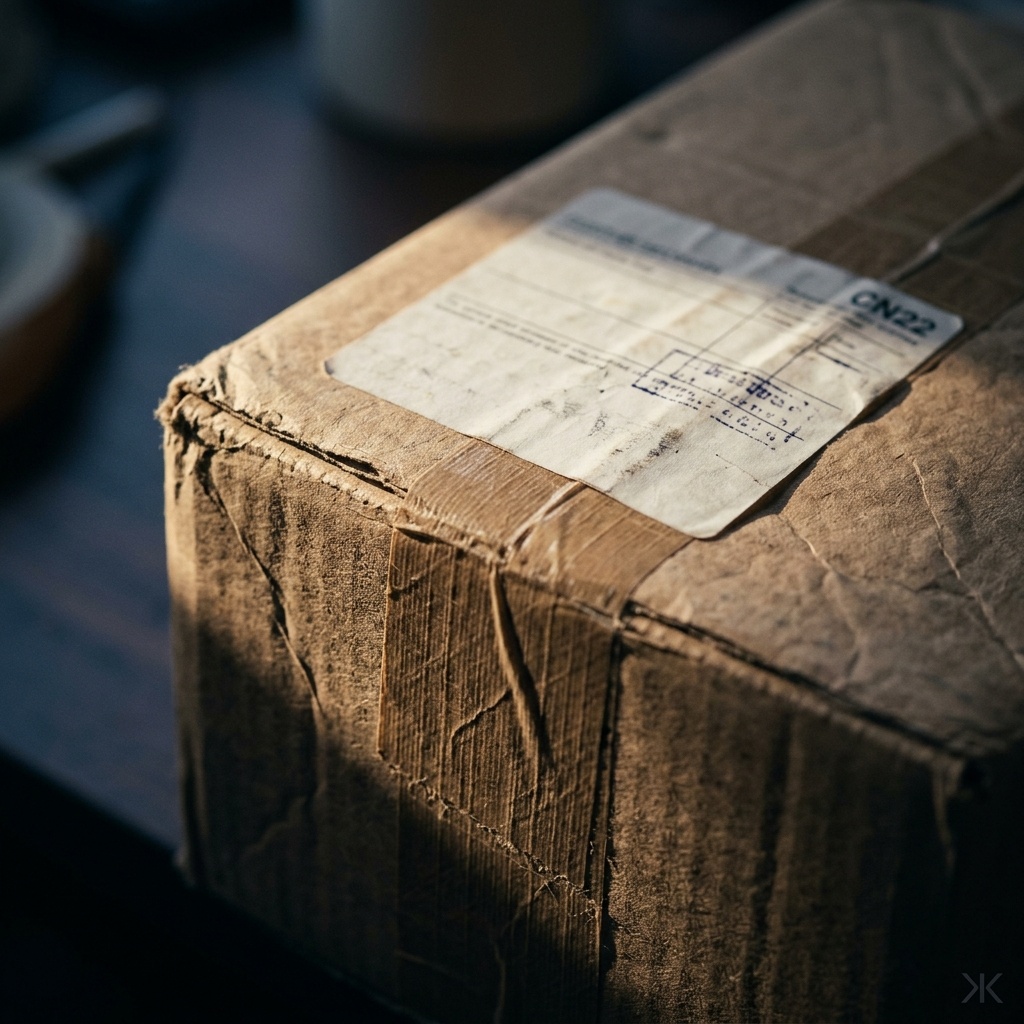
The mechanism is called de minimis (Latin for “too small to matter” — the import value below which the government waved a shipment through duty-free). It lives in Section 321 of the Tariff Act, and in 2016 Congress raised the ceiling from $200 to $800 under the Trade Facilitation and Trade Enforcement Act.
The volume that poured through that door is the whole story. De minimis shipments grew from 140 million in 2014 to 1.36 billion in 2024 — roughly four million packages a day. A rule meant for tourists' souvenirs had become the plumbing of cross-border e-commerce.
Then it closed in two steps: China and Hong Kong on May 2, 2025, and every other country on August 29, 2025. This isn't a tariff that sunsets — the One Big Beautiful Bill Act gives statutory authority to keep de minimis eliminated from July 1, 2027. Plan as if it's permanent, because the law is built that way.
“The duty was never the thing that mattered most. The paperwork was. De minimis didn't just waive a fee — it waived an entire customs process, and that process is back.”
The model that just broke
Picture the setup a lot of brands ran: inventory sits in an overseas 3PL (third-party logistics warehouse), and each US order ships individually, direct to the customer, under $800. No duty, no broker, no entry. The landed cost of a tee was basically its factory price plus postage.
Every one of those individual parcels now needs a customs entry — informal for shipments under $2,500, formal above it — plus duty and a Merchandise Processing Fee (the CBP charge on imports, 0.3464% of value with a floor and ceiling). On top of that sits the part nobody budgeted for: a per-parcel brokerage fee (what a customs broker charges to file each entry).
The result is a fixed toll on every box, and fixed tolls punish small orders hardest. Brokerage and processing run roughly $15 to $25 per parcel — a rounding error on a pallet, a margin-killer on a single tee.
The $40 order, before and after
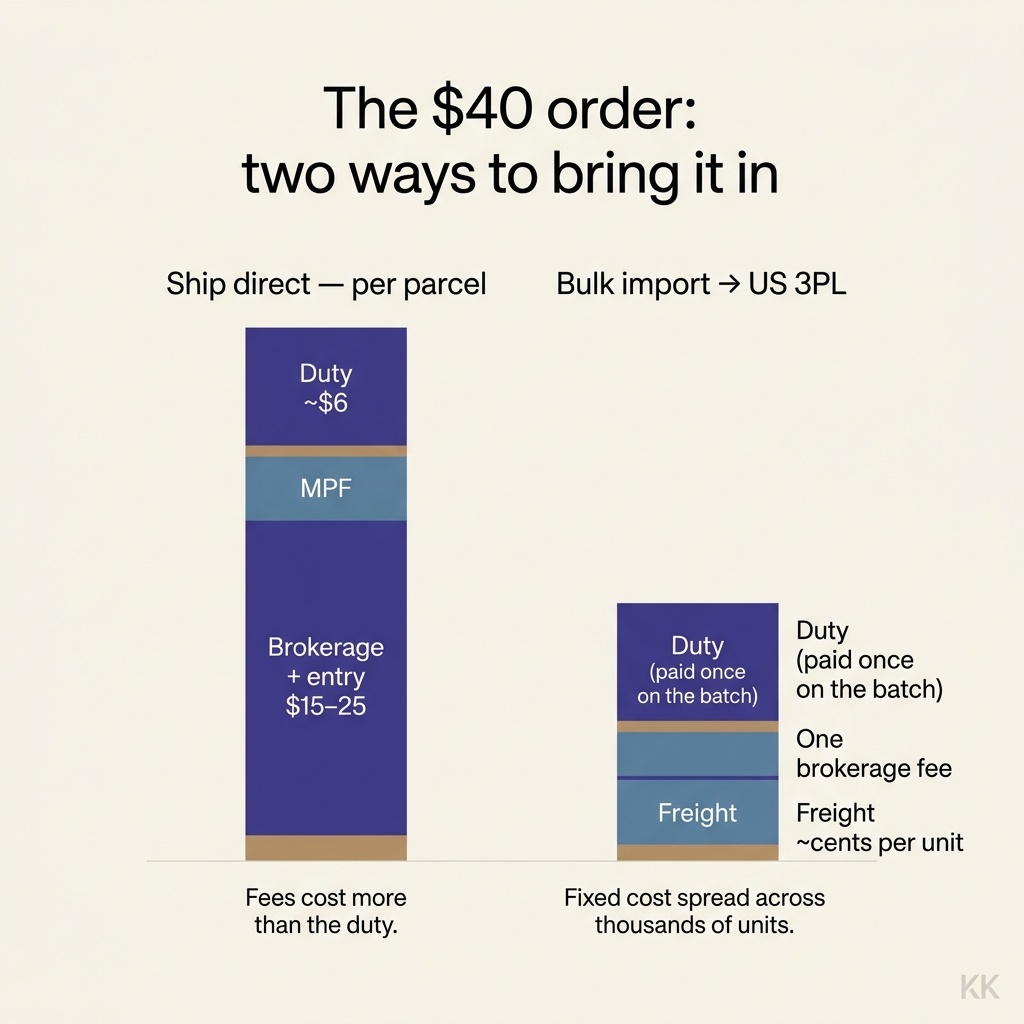
Run a real one. A $40 cross-border order of a single knit top, shipped direct from an overseas warehouse.
Before: $0 duty, no entry, no broker. The cost was the garment and the postage.
After: duty on $40 of apparel is only six or seven dollars — but the entry and brokerage add another fifteen to twenty-five. For parcels under about $200, the fixed processing cost routinely exceeds the duty itself.
That's the line worth sitting with: the tariff isn't what broke direct-ship. The fee is. You can't out-source-country your way around a flat charge that lands on every box regardless of where it came from.
“Don't re-cost per garment. Re-cost per parcel. The new tax is on the act of shipping a box across the border — not on the shirt inside it.”
Free download
The Post-$800 Import Model Calculator
A one-page sheet that runs your monthly order volume both ways — parcel-by-parcel entry vs. bulk import + US 3PL — and shows the exact volume where consolidating starts paying for itself. PDF.
The move: stop shipping parcels across the border
The fix isn't a cheaper origin. It's changing how the goods enter the country.
Consolidate. Instead of a thousand small parcels each triggering their own entry, send one bulk ocean or air shipment to a US 3PL (a domestic warehouse that stores your inventory and ships orders for you). You file a single customs entry, pay duty once on the whole batch, and fulfill US orders domestically. One $15–25 brokerage fee spread across thousands of units is cents, not dollars, per garment.
The freight math currently helps. A 40-foot container from Shanghai to LA was running around $2,256 in early 2026 — well off the 2024 peaks — and a container holds thousands of units, so amortized freight per piece is trivial. The window to build inventory cheaply is open right now.
Signs your import model is still stuck in the old rules
- • Your COGS sheet still assumes “duty-free under $800.”
- • Orders ship one-by-one from an overseas warehouse, not a US one.
- • You're comparing factory countries instead of comparing per-parcel vs. bulk entry.
- • You haven't priced a US 3PL because “we've always shipped direct.”
When staying put still makes sense
This isn't universal. If you already import in bulk and fulfill from the US — which most brands selling through wholesale or a US marketplace do — almost nothing here changes; you were never exposed.
And consolidation has a real cost: you're now holding inventory, which ties up cash and adds the risk of buying the wrong sizes. A true made-to-order or ultra-low-volume brand may still find per-parcel entry cheaper than a warehouse full of stock it hasn't sold. The right answer is a calculation, not a reflex — run your actual order volume against the fixed-fee-per-parcel before you sign a 3PL.
The bottom line
The $800 rule rewarded brands for staying small and shipping direct; the new rules reward brands for buying ahead and landing inventory in bulk. That's not a tax change — it's a different operating model, and the founders who rebuild around it now will quietly out-margin the ones still paying a toll on every box. If you mapped your last hundred orders against a single bulk entry, which way would the math fall?
Read next
8 min read
The July 24 Tariff Cliff: Re-Cost Fall Before It Lands
The blanket tariff that expires mid-summer — and the bet every Fall PO makes.
7 min read
The US-Plus-One Sourcing Playbook for 2026
Spread risk across origins without doubling your overhead.
8 min read
On-Demand Manufacturing in 2026
When made-to-order beats holding inventory — and when it doesn't.
Comments
No comments yet
Be the first to share your thoughts!