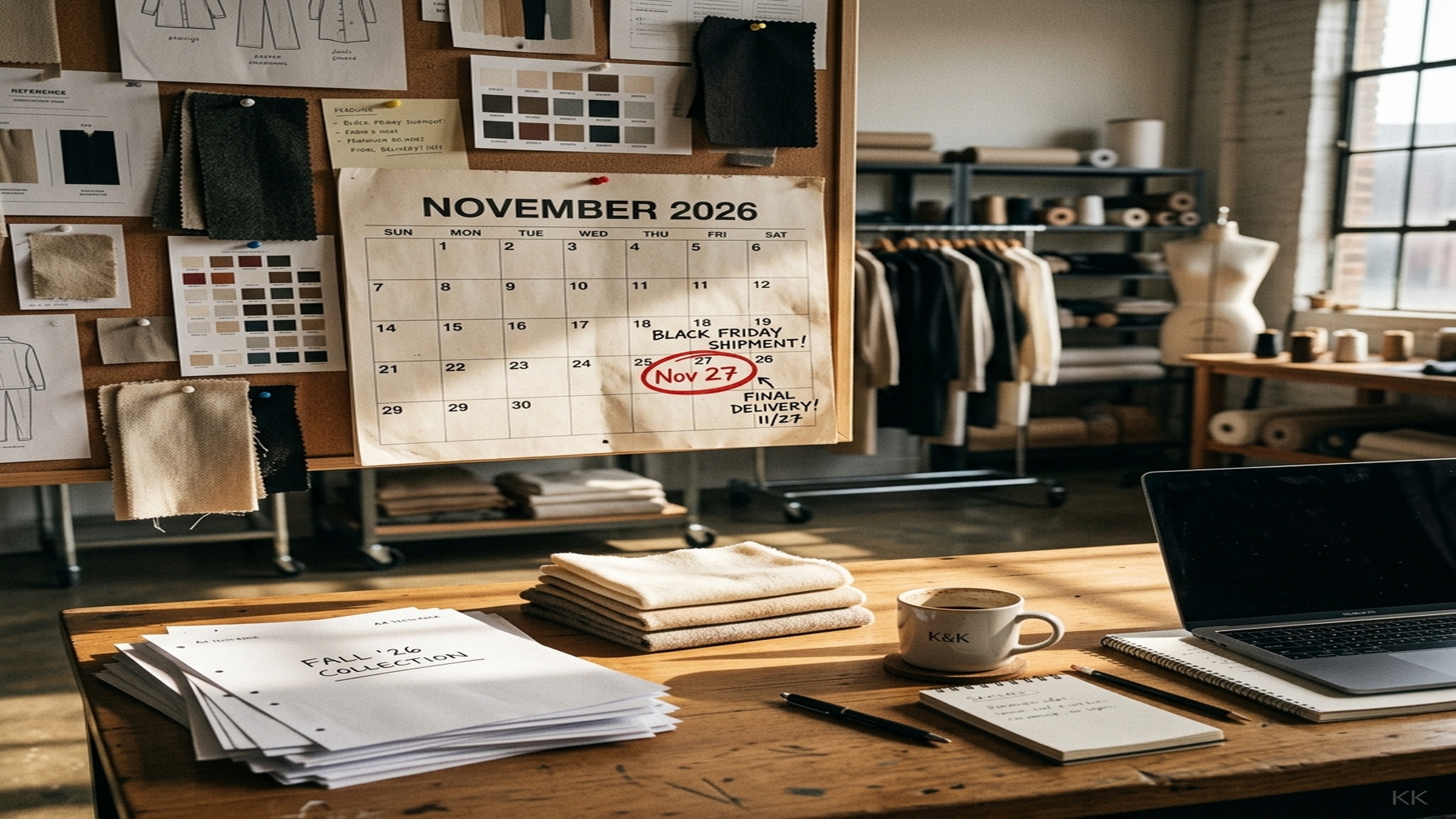
Holiday revenue is built on a date that didn't move. Black Friday 2026 lands on Friday, November 27 (per NRF's US holiday calendar). What did move — and what most US founders are still pricing wrong — is the production calendar that has to sit behind it.
The window for overseas holiday production opens once a year, and it opens now. Start the cycle in late August and you do not ship holiday — you ship March arrivals and apology emails.
What follows is the math, the calendar, and the three things to lock this month if you want product on shelves, not in next year's clearance bin.
The actual deadline is this month, not November
The instinct is to count back from Black Friday. The actual reference point is the date your retail partners and your DTC warehouse expect product on the shelf — for a smooth launch, that's early November, not late.
Back of envelope: product has to land in the US warehouse roughly three weeks before it sells. That anchors the "in-warehouse" date around the second week of October. Everything else falls out of that one number.
So when a founder asks in August whether there's still time, the honest answer is no. The honest answer in June is "yes, if you act this month."
“The cost of being three weeks late on a holiday SKU isn't a delay. The shelf goes to a competitor.”
That gap between when founders think the deadline is and when it actually is — that's where most of the brand-killing missed seasons happen. Holiday is the single season where landed cost matters less than landed-on-time.
What a 4–5 month overseas cycle actually looks like
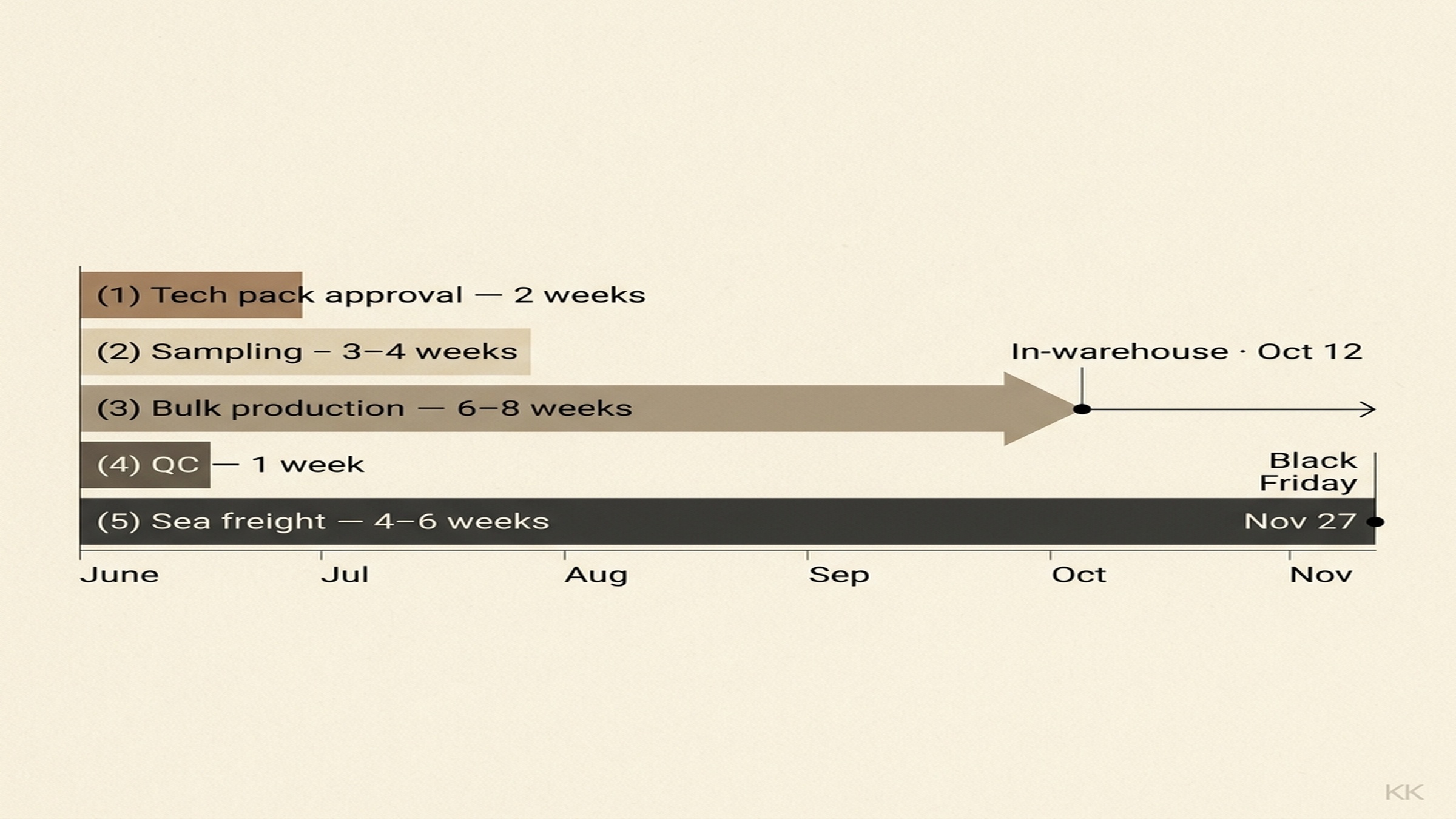
The overseas-manufacturing cycle is five stages, each with a non-negotiable floor on time. Compress one stage and cost or defect rate moves into the next. Compress two and the chain breaks.
Here's the realistic stage-by-stage. Each duration assumes a competent factory with an existing relationship — first-time engagements add 2–4 weeks for onboarding and trust-building (McKinsey's State of Fashion tracks this drift year on year).
- 1
Tech pack approval → first sample request
Tech pack: the engineering spec for a garment — measurements, materials, construction, trims. 2 weeks.
- 2
Sampling → approval
Sampling: iterative back-and-forth where the factory builds prototypes until the brand signs off. 3–4 weeks, longer for premium fabrics or first-time construction.
- 3
Bulk production
Bulk run: the main production order after sample approval. 6–8 weeks, gated by factory capacity and fabric lead time.
- 4
In-line and final QC
AQL: Acceptable Quality Level — the statistical sampling standard used to accept or reject a finished run. 1 week.
- 5
Sea freight to US port
4–6 weeks depending on origin and carrier reliability; add 1 week for US inland transit.
Add it up: roughly 16 to 21 weeks door-to-door for a competent overseas cycle. That's 4 to 5 months, every time. Counting back from an October 12 in-warehouse date lands you at a late-May-to-late-June production start — for most US brands, that's this month.
“16 to 21 weeks door-to-door. That is 4 to 5 months, every time.”
Domestic and near-shore production change this math — see the counterexample below. But for anyone ordering from India, Vietnam, Bangladesh, Turkey, or Indonesia, the calendar is the calendar.
Three decisions to lock by the end of this month

If overseas production is the path, three things have to be locked before July. Each one gates the next stage of the calendar. Each one fails the same way — quietly, in slow motion.
1. Lock your styles (carryover vs. new)
Every holiday assortment splits into two buckets: carryover styles your retail partners already know, and new styles you're betting on. The fastest way to miss the window is to leave that ratio undecided.
Carryover rides a shorter cycle — the tech pack is approved and the factory has run it before. New styles need full sampling and approval, which is where the three-to-four-week stage actually lives.
The June decision isn't just "what styles." It's which styles are new and which are carryover, and how many of each.
Signs you're making this mistake
- • Your line plan still has "TBD" next to half the holiday SKUs in June.
- • Your sales team is pushing one more new style with no carryover discipline.
- • Last year's holiday sell-through report hasn't been opened before deciding the 2026 mix.
2. Lock your materials (premium fabric is the slowest input)
Fabric is the longest-lead input in the entire cycle. Standard mill-stock fabrics ship in 1–2 weeks; mill-to-order or premium fabrics run 6–10 weeks before they even reach the factory.
Founders who try to spec a "new fabric" experience in August aren't adding a fabric — they're cancelling holiday. Same for any fabric that needs development: custom prints, branded weaves, specialty finishes.
The June decision is to lock fabric on every new style: confirm GSM (grams per square metre — the standard fabric-weight unit), composition, mill, and whether it's stock or mill-to-order. Then place the deposit.
Signs you're making this mistake
- • You're shopping for "interesting fabrics" with no PO behind them.
- • You're betting holiday on a custom print where the strike-off hasn't been approved.
- • Your fabric supplier hasn't quoted a delivery date to your factory yet.
Free download
The Holiday 2026 Production Countdown
A one-page calendar with every decision date, deposit milestone, and QC checkpoint between June and the October in-warehouse anchor. PDF.
3. Lock your production slot
Factories sell time. Holiday is the season every brand pulls forward into — which means by mid-July, the best factories' calendars are gone. You aren't paying for fabric and labor. You're paying for a slot on a finite calendar.
A locked slot means a deposit paid, a PO acknowledged, and a production start date written into the factory's master plan. A verbal commitment isn't a slot.
Without one, you're sourcing from leftover capacity in September — at rush rates, with the QC discipline that gets sacrificed when a factory is on the back foot. That's where most missed-holiday brand failures trace back to.
Signs you're making this mistake
- • You're still in "quote shopping" mode in late June.
- • No deposit has changed hands by the end of July.
- • Your factory hasn't named a specific bulk-production start date.
When the standard timeline doesn't apply
Two operating models break the 4–5 month rule, both at a cost.
Domestic or near-shore production (US, Mexico, Caribbean Basin) compresses the calendar to roughly 8–10 weeks. Freight collapses, the factory is on the same time zone, and reorders are realistic mid-season. The trade-off is unit cost — and for some categories, a narrower fabric and finish library than India or Vietnam offer.
On-demand production shortens the window further, because there is no bulk to schedule. The trade-off is a different per-unit cost and a different brand promise — on-demand is its own operating model, not a backup plan for missing a June lock. Brands that work this way design their merchandising calendar around it from day one.
Reading this in June with an overseas partner: the window is open. Reading this in August on bulk-overseas: the window is closed, and the conversation shifts to spring 2027.
What we'd do in your shoes this month
Pull last year's holiday sell-through on Monday, lock the carryover-versus-new split by Friday, and have fabric POs in by end of next week.
Pay the slot deposit before issuing the next sample request — slots are the constraint, not samples.
Treat July as the month you execute the plan you make in June, not the month you make it.
Read next
8 min read
The Lead-Time Timeline: Design to Doorstep
Every stage of the 90-day cycle, with realistic week counts.
7 min read
On-Demand Clothing Manufacturing in 2026
The model that compresses lead time — and what it costs to use it.
9 min read
Why 80–90% of US Clothing Brands Fail in 5 Years
Four operational mistakes — including the missed-window one.
Comments
No comments yet
Be the first to share your thoughts!