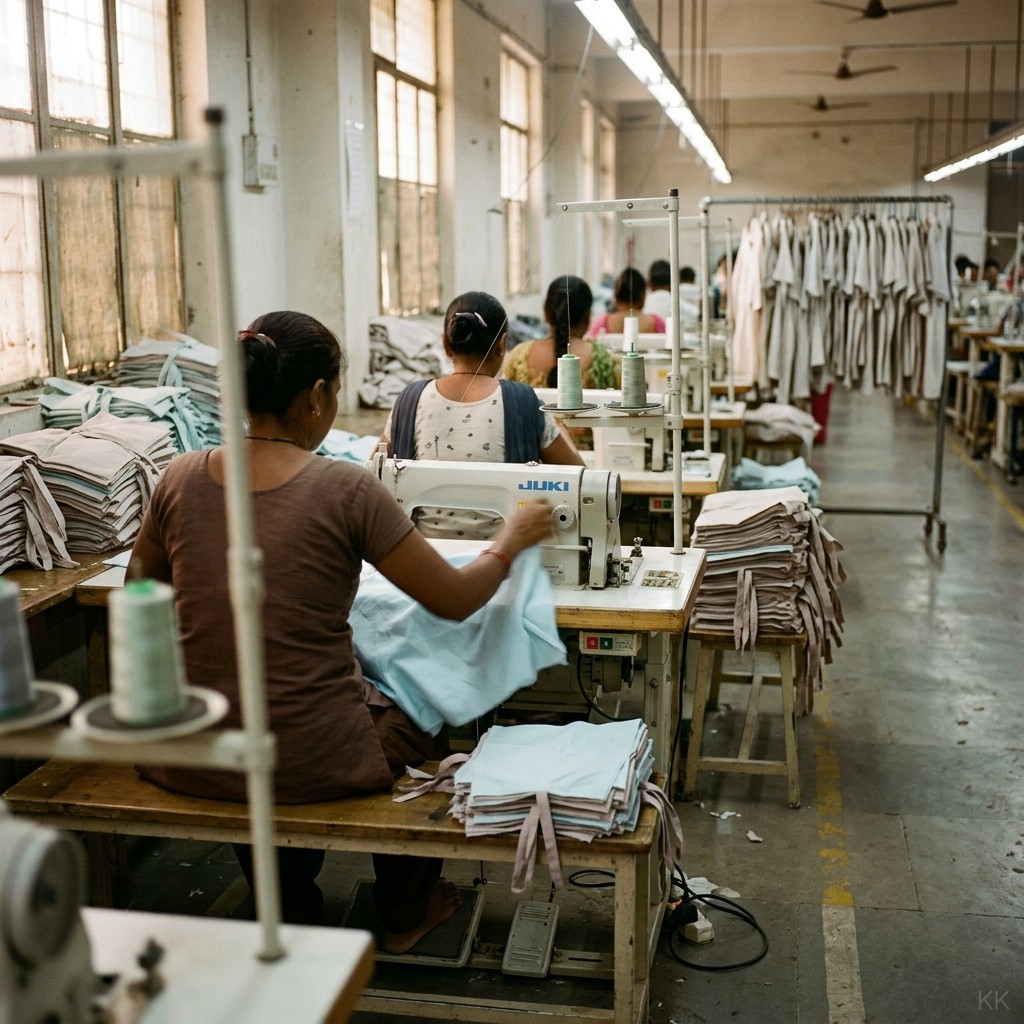
You have a design, a name, and about eight thousand dollars. Then the first factory you email writes back asking for 500 pieces per color.
That is the moment most clothing brands quietly die — not from a bad product, but from a minimum they could not clear. So the search begins for a no MOQ clothing manufacturer, and the results are full of suppliers promising exactly that.
Some of them mean it. Most of them mean something narrower. This is what the promise actually covers, what small batch clothing production costs when you price it honestly, and the point at which staying small stops being smart.
What “no MOQ” actually means
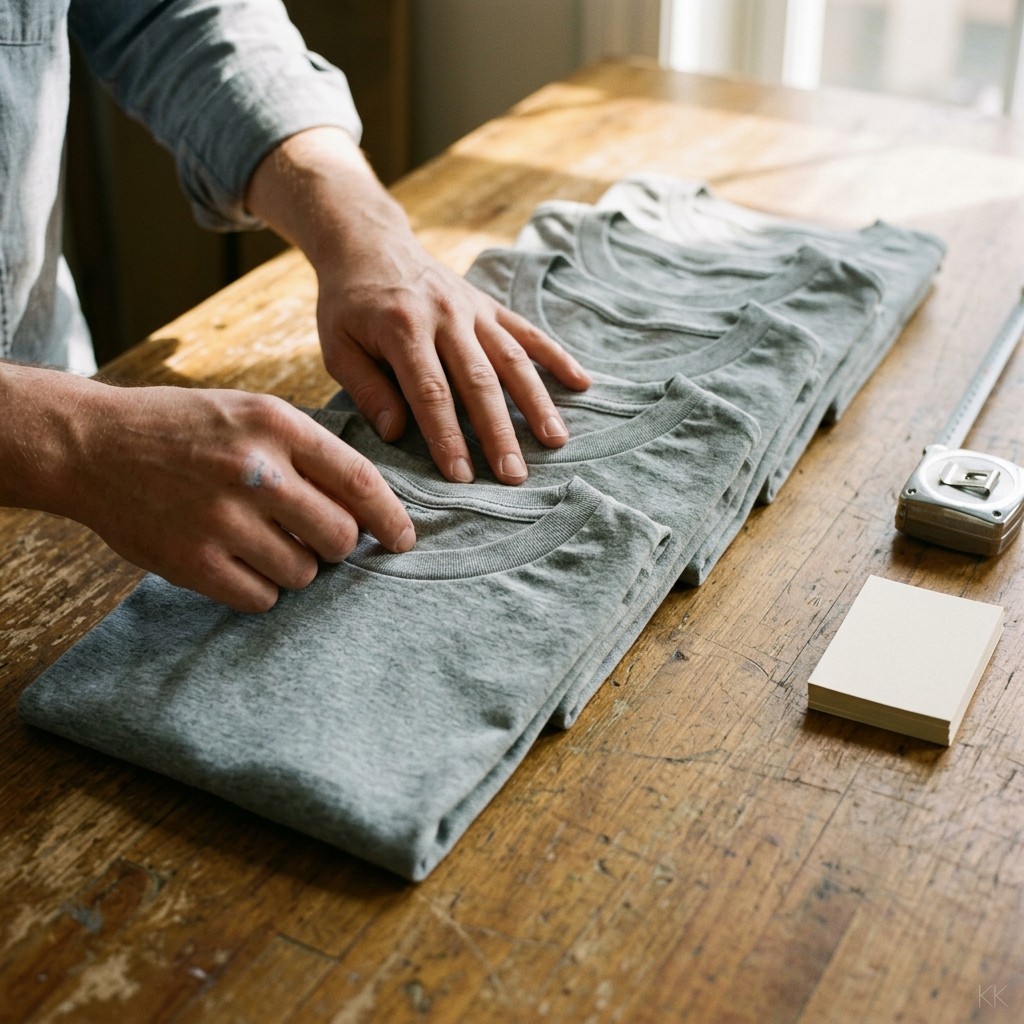
MOQ (minimum order quantity — the smallest run a supplier will accept) is normally set per style and per color. A factory quoting “500 minimum” usually means 500 of one design in one color, not 500 pieces spread across your range.
That distinction is where most of the confusion lives. A supplier can honestly advertise no minimum and still be unable to make the garment you have in mind, because the constraint sits one step upstream from them.
In practice the phrase covers three different claims. Knowing which one you are being offered saves a lot of wasted email.
| What they say | What it usually means | Real floor |
|---|---|---|
| “Zero MOQ” | Printing or embroidery on a blank garment somebody else mass-produced. Your design is on the surface, not in the pattern. | 1 piece |
| “No MOQ” | A sample room or small workshop that will cut and sew your pattern in tiny quantities, usually from fabric already in stock. | 10–30 pieces |
| “Flexible MOQ” | One minimum held across a whole collection or a season, rather than style by style. The most useful version for a real brand. | 50–150 per style |
None of these is dishonest. They are different products. The mistake is comparing a zero-MOQ print price against a cut-and-sew quote and concluding one supplier is cheap and the other is greedy. We walked through the full launch version of this in the zero-MOQ, no-warehouse launch playbook.
“Ask what the fabric minimum is. The factory’s number is negotiable. The mill’s number usually isn’t.”
Why minimums exist at all
It helps to know that a minimum is not a negotiating tactic. It is arithmetic, and it starts before the factory.
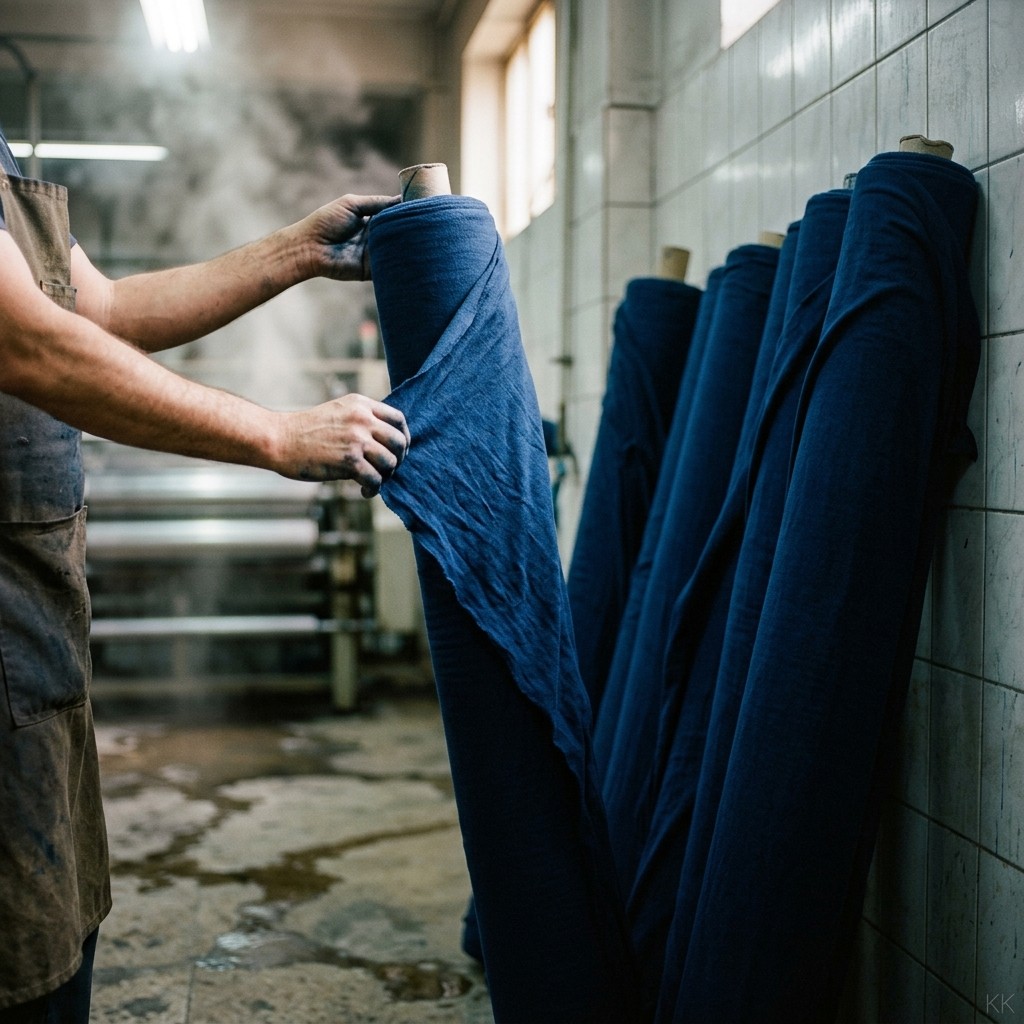 Fabric is made in runs. A mill knits or weaves to order and a dye lot (one batch of cloth dyed together to a single color) has a minimum size, because setting up a dye machine costs the same whether it processes 50 kilos or 500. Ask for 30 metres of a custom color and you are asking the mill to run a machine at a loss.
The same logic repeats down the line. Someone has to make a pattern, grade it across sizes, plan a cutting marker, thread and calibrate a sewing line, and file one customs entry. Those costs land once per style, whatever the quantity.
Infographic 04
Where a minimum order quantity actually comes from
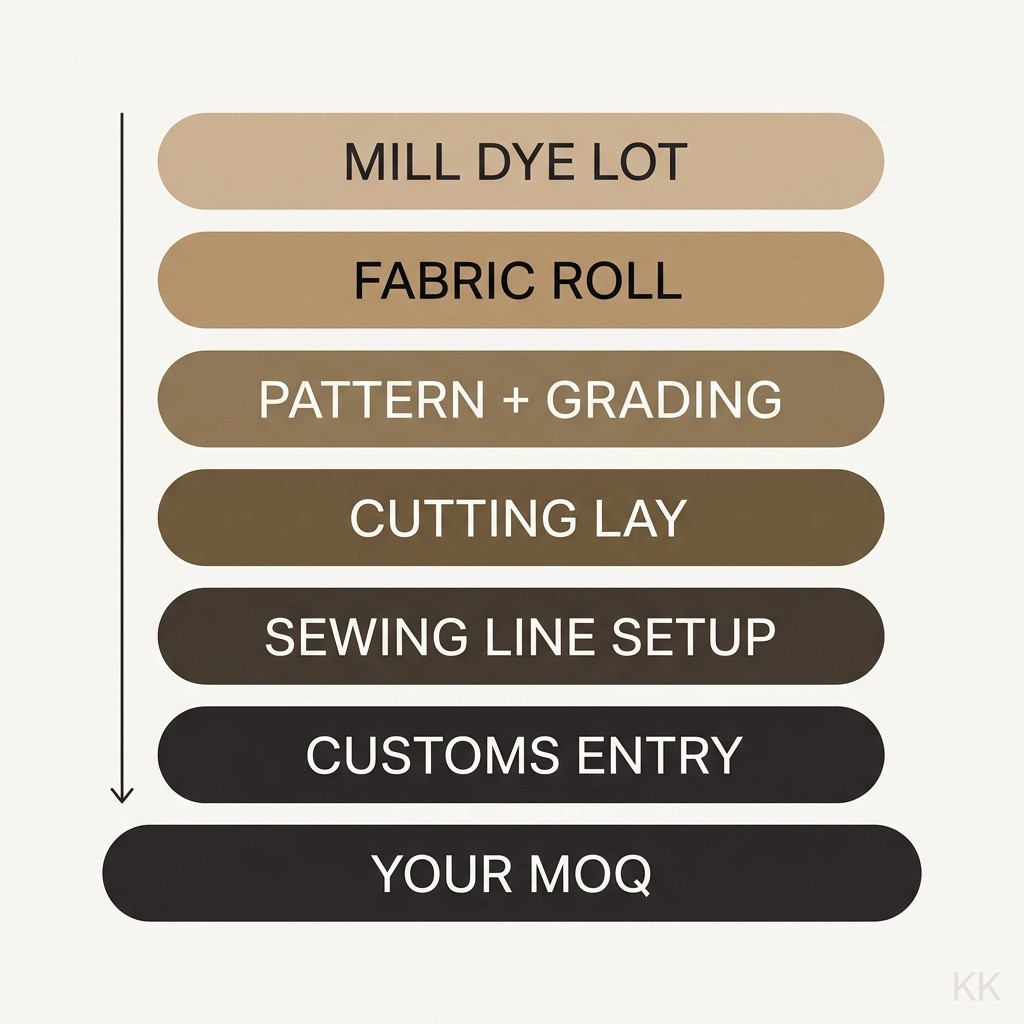
Which is why a factory with a 500-piece minimum is usually telling you the truth about its own economics rather than dismissing you. And it is why every real workaround is some version of the same trick: use fabric that already exists, or share the setup cost with other people.
Questions that reveal the real minimum
- • Is this fabric in stock, or does it need to be knitted for me?
- • What is the dye-lot minimum for this color, in kilos or metres?
- • Does the minimum apply per style, per color, or across the order?
- • What changes about the price if I take a color you already hold?
The four routes to a first order
1. Print-on-demand. Your artwork goes onto a blank garment when an order comes in, so nothing is made until something sells. The trade: you control neither fit, fabric nor construction — you are selling somebody else’s tee with your graphic on it, and so is everyone else using that supplier. Good for testing a graphic, poor for building a garment brand. The economics are in our piece on on-demand manufacturing.
2. The sample room. Most manufacturers run one, and some will sell you short runs out of it. You get your own pattern, your own construction, and a garment that is genuinely yours. You also pay sample-room rates, because that is what it is. Ten to twenty-five pieces is the normal range.
3. The small cut-and-sew workshop. A ten-to-thirty-machine shop that lives on short runs. Minimums are typically 30 to 100 pieces, fabric choice is limited to what is nearby or in stock, and quality varies enormously between shops. Vet this one hard — the failure modes are the ones we catalogued in the real cost of choosing the wrong manufacturer.
4. The flexible-minimum partner. A full-service manufacturer that holds one minimum across your whole collection instead of per style. Six styles at 50 pieces each clears a 300-piece minimum, so you launch a real range rather than one hero product in six colors. Usually the best structure for a brand that intends to still exist in three years — read how flexible-quantity arrangements work in practice before you negotiate one.
A fifth option people forget: buy a factory’s existing block and change the fabric, trims and labels. Not custom, but fast and cheap, and for some categories the correct answer — see private label vs. custom manufacturing.
What small runs cost per piece
Here is the part the supplier listings leave out. Flexibility is a real service and it has a real price, and that price is charged per garment.
Infographic 01
The same tee, six order sizes
Factory price per unit for one mid-weight cotton crew tee, built from your own pattern. Worked example, not a price list.
Then there is the cost that ignores quantity entirely. Before anything sellable exists, someone has to turn your idea into instructions: a tech pack, a base pattern, grading across your size run, two or three sample rounds, color approvals. Budget roughly $500 to $1,500 per style, and expect to pay it whether you order 30 pieces or 3,000.
At 1,000 units, $900 of development adds ninety cents to each garment. At 150 units it adds six dollars. That single line is most of why small runs feel so expensive, and it is also the line founders most often try to skip — which is the most reliable way to pay for it twice, as we argued in what a tech pack actually is.
Import costs work the same way, and they are worth knowing before they surprise you. Duty is charged as a percentage of value, so it scales with your order rather than penalizing small ones — a cotton knit tee sits under HTS 6109.10.00 at a 16.5% general rate whether you bring in 30 pieces or 3,000. What does penalize small orders is the fixed side: customs charges a minimum processing fee per formal entry and a broker charges a flat fee to file it, so a 100-piece shipment carries those same dollars across far fewer garments.
“Flexibility is not free and it is not a discount. It is a service, and it is billed per garment.”
Free download
The Small-Batch Planner
A one-page worksheet that turns any quantity into the three numbers that decide it: all-in cost per unit, total cash at risk, and how many pieces you have to sell to get your money back. Plus the eight questions to send a supplier before you ask for a price. Spreadsheet + PDF.
The number that beats unit cost
Everything so far argues for ordering more. Cost per unit falls, margin rises, the spreadsheet gets happier. And this is precisely where new brands get hurt.
Cost per unit is a measure of efficiency. It tells you nothing about risk. Before you know whether a product sells, the number that decides whether you survive is how much cash is sitting in boxes.
Infographic 02
Same product, two bets
One tee, one pattern, $900 of development either way. The only thing that changes is how many you make.
| 150 units | 1,000 units | |
|---|---|---|
| Factory price per unit | $15.00 | $8.00 |
| Development, spread out | $6.00 | $0.90 |
| All-in per unit | $21.00 | $8.90 |
| Total cash at risk | $3,150 | $8,900 |
| If 150 sell at $45 retail | +$3,600 | −$2,150 |
| Units left in the storage unit | 0 | 850 |
The bulk order is genuinely the better business — if the product sells. Move all 1,000 at $45 and you clear about $36,100 against $3,600 on the small run. Nobody should pretend otherwise.
The question is what happens when it does not. That risk is not hypothetical: clothing retailers were carrying 1.99 months of inventory against monthly sales in May 2026, on Census Bureau figures — and that is the whole sector, including the operators who forecast for a living.
Meanwhile the conditions are not getting friendlier. In the McKinsey and Business of Fashion State of Fashion 2026, 46% of fashion executives expected conditions to worsen over the year. Placing a large first order into that is a forecast, not a strategy.
Who no MOQ is right for
Small runs are the right call more often than the industry admits, and the reason is simple: most brands are financing this themselves. Startups two years old or younger make up 34% of all small employer firms in the Federal Reserve’s Small Business Credit Survey. Very few of them have the balance sheet to absorb a bad guess about which color sells.
The odds argue for caution too. Of business establishments born in 2013, 34.7% were still operating a decade later, according to the Bureau of Labor Statistics. Most brands do not get a second chance to place a first order.
Go small if
- • Nobody outside your circle has paid full price for this yet.
- • You are launching several styles and cannot fund a real run of each.
- • Fit is still moving, or the fabric is not locked.
- • You sell direct and can restock in weeks, not seasons.
- • Losing the whole order would end the business.
Go bigger if
- • The style has sold through at full price at least twice.
- • You have a wholesale order or a retail date to hit.
- • You know your size curve from real sales, not guesswork.
- • The small-batch price is squeezing your margin below survival.
- • You need a specific fabric that carries its own minimum anyway.
One honest caveat. Small runs can make a good product look like a failure. A style that would earn 60% margin at 500 units might show 25% at 40 units, and a founder reading only the margin line kills it. Judge a test run on whether it sold and how fast, not on what it earned.
How to climb out of it
No MOQ is a starting position, not a business model. Stay there too long and the per-unit price quietly caps how much you can spend to acquire a customer, which caps how fast you can grow.
The way up is one rung at a time, with each step paying for the information that justifies the next.
Infographic 03
The MOQ ladder: four rungs, one question each
Each step buys an answer. Take the next one only when the last question is settled.
- 01 Prove the garmentDoes it fit, hang and feel the way it did in your head?
- 02 Prove the demandWill people who don’t know you pay full price for it?
- 03 Prove the repeatDoes it sell through twice, and which sizes go first?
- 04 Scale itHow much can this style earn now that nothing is a guess?
Two practical notes. Keep the same pattern and the same factory as you climb, because changing either resets the development cost and the learning curve. And plan the calendar backwards from your selling window — a bigger run takes longer to make, and the weeks are laid out in the lead-time timeline from design to doorstep.
The signal to move up is boring and specific: the same style sold out twice at full price, and you can name the sizes that went first. That is a restock. Anything before that is still a guess with a bigger number attached.
When no MOQ is the wrong call
Sometimes the small order is the expensive mistake. If your product depends on a specific performance fabric, a custom knit, or a matched color, no supplier can hand it to you at 30 pieces — the mill minimum makes it impossible at any price you would accept. Chasing a no-MOQ version of that garment gets you a worse product in whatever cloth was on the shelf. Wholesale shifts it too: a buyer placing a 400-piece order has already answered the demand question, and paying small-batch rates to fill it can wipe out the margin the order was worth.
And there is a quieter failure: staying small forever. A brand that has sold the same tee out four times and is still ordering 50 at a time is paying roughly twice per garment for information it already has. That is not caution. That is a habit.
What we’d do in your shoes
Stop shopping for the lowest minimum and start shopping for the partner who will still be there at rung three. Ask every supplier the same two questions: what is your minimum per style, and what does the price look like at 50, 150 and 500. The answers tell you whether they want a transaction or a brand.
Then size your first order by what you can afford to lose, not by what makes the unit cost look respectable. What is the smallest run that produces a garment you would put your name on — and could you write that check twice if the first one taught you something?
Common questions
What is a no MOQ clothing manufacturer?
A production partner that will make your garment without a fixed minimum order quantity per style. In practice it means one of four setups: print-on-demand on blank garments, a sample room selling short runs, a small cut-and-sew workshop, or a full-service partner holding one flexible minimum across a whole collection. Very few factories genuinely start at one piece — most of what is marketed as no MOQ is a low MOQ of roughly 10 to 50 units per style.
Is zero MOQ clothing manufacturing actually possible?
Yes, but only for certain routes. Print-on-demand is genuinely one piece at a time, because you are printing on a blank someone else already made in bulk. True custom cut-and-sew from your own pattern almost never starts at one, because the fabric mill, the dye house and the cutting table all have minimums of their own. When a supplier advertises zero MOQ on custom production, ask what the fabric minimum is. That is where the real floor sits.
How much does small batch clothing production cost per piece?
For a mid-weight cotton crew tee built from your own pattern: roughly $30 to $45 a unit at 10 to 25 pieces, $20 to $30 at 25 to 50, $14 to $22 at 50 to 150, $9 to $13 at 300 to 500, and $6.50 to $9 at 1,000 and up. On top of any of those, one-time development for the style — tech pack, pattern, grading, samples — runs about $500 to $1,500 and does not get cheaper with quantity.
What is the catch with no MOQ clothing manufacturing?
Three things. You pay two to four times more per garment, because the fixed cost of setting up a style is shared across very few units. Your fabric and color choices narrow to whatever the supplier already holds. And the per-unit economics can look so bad that a product which would be profitable at 500 units reads as a failure at 30 — so judge a small run on whether it sells, not on its margin.
When should a brand move from no MOQ to a bulk order?
When the same style has sold through at full price at least twice, and you can name the sizes and colors that sold first. That is the point where a bigger run stops being a guess and starts being a restock. Moving up one rung at a time — roughly 25, then 150, then 500 — keeps cash at risk low while each step buys you real information about demand.
Read next
8 min read
On-Demand Manufacturing in 2026
Producing less and selling more, and where the model stops working.
8 min read
Private Label vs. Custom Manufacturing
Two routes to a first order, and what each one really costs you.
7 min read
The Lead-Time Timeline
Design to doorstep, week by week — and where the weeks actually go.
Comments
No comments yet
Be the first to share your thoughts!