The $800 exemption died on a Friday in August 2025. The bill for it arrives on a Tuesday in July 2026, buried in a fulfillment invoice nobody reads line by line.
2026 is the first full year in which every parcel entering the United States owes duty. The temporary flat-fee bridge for postal shipments is gone, and in June, CBP (US Customs and Border Protection — the agency that clears every import) made the suspension indefinite by rule rather than by executive order.
We covered the rule when it landed — every parcel pays now. This is the mid-year check with numbers instead of forecasts: one tee, two routes, and the arithmetic that has quietly reorganized how clothing gets to American doorsteps.
Six months in, the volume voted

De minimis (the rule that let shipments under $800 enter duty-free) was not a loophole at the margins. It was the road. More than a billion low-value shipments a year came through it before the suspension took effect on August 29, 2025 (CBP).
Then the road closed. US-bound postal volumes fell by more than 80% on carrier measures, and at least 88 national postal operators suspended US-bound parcel acceptance at some point during the transition (Air Cargo News). The USPS filing for fiscal 2026 projects a 42% revenue decline in its international mail and packages segment, including a 56% drop for inbound (Supply Chain Dive).
Anyone still waiting for a reversal should read June. On June 24, 2026, CBP issued two interim final rules that suspend the exemption indefinitely — one covering every mode except international mail, and one covering mail, which also builds a new postal informal-entry process for goods valued at $2,500 or less. The postal rule took effect July 24, with a compliance date of October 22, 2026 (Thompson Hine).
A regime that moves from an emergency order into the Code of Federal Regulations is not a regime that expects to be temporary. Plan against the rule, not the appeal.
“When a policy stops being an executive order and starts being a regulation, it has stopped being a news story and started being your cost sheet.”
What one parcel actually costs now
Take a real unit. A cotton knit tee, made in India, $9.00 FOB (free on board — the supplier's price at the origin port, before freight and duty), sold direct to a US customer at $48.
Start with the number most founders get wrong. Duty is assessed on transaction value (the price actually paid for the goods sold for export to the US). When you ship direct to a consumer, that transaction is the retail sale — so the duty base is the $48 your customer paid, not the $9 you paid the factory (Passport).
The rate: cotton knit tees carry a 16.5% MFN (most-favored-nation — the baseline WTO rate) duty under HTS 6109.10.00, plus the 10% Section 301 forced-labor surcharge that replaced the expired Section 122 blanket for India and 16 other economies on July 24, 2026. Call it 26.5%.
| Route A — ship direct | Per parcel |
|---|---|
| Duty, 26.5% of the $48 paid | $12.72 |
| MPF, informal entry (automated), FY2026 | $2.69 |
| Carrier disbursement fee | $17.50 |
| International parcel freight, ~500 g | $14.00 |
| Total per order | $46.91 |
MPF (merchandise processing fee) on an automated informal entry is a flat $2.69 in FY2026. The disbursement fee is what a carrier charges to front your duty: FedEx raised its to the greater of $17.50 or 2.5% on July 20, 2026. Some services bill a separate clearance-entry fee on top.
Now finish the sum. Forty-eight dollars in, $46.91 of delivery cost out, and the tee itself still cost $9.00 to make. That order is $7.91 underwater — before payment processing, before a dollar of paid acquisition, before anyone gets paid.
That is the whole reason a billion parcels stopped moving. Not principle. Arithmetic.
Signs your parcel math is still stale
- • Your cost sheet still applies duty to your FOB price on orders you ship direct.
- • You budget duty as a percentage and have no fixed per-parcel line for MPF and disbursement.
- • Your CFO number for shipping is a blended average that predates August 2025.
- • Nobody has checked whether your origin sits in the 10% or 12.5% Section 301 bucket.
The same tee, bulk-imported into a US 3PL
Same tee. Same duty rate. Different door. Import 3,000 units on one ocean entry, receive them into a 3PL (third-party logistics provider — a warehouse that stores and ships your inventory), and fulfil the same $48 order domestically.
Now the duty base is what you actually paid the factory: $9.00. The customs bill drops from $12.72 to $2.39 without a single line of trade policy changing.
| Route B — bulk import + US 3PL | Per order |
|---|---|
| Duty, 26.5% of the $9.00 FOB | $2.39 |
| MPF, 0.3464% of $27,000, spread over 3,000 | $0.03 |
| Harbor maintenance fee, 0.125%, spread | $0.01 |
| Ocean freight + drayage ($1,350), spread | $0.45 |
| Customs brokerage, one entry ($150), spread | $0.05 |
| 3PL receiving | $0.10 |
| Storage, ~60 days average | $0.15 |
| Pick and pack, first item | $2.75 |
| Domestic ground, 1 lb | $7.20 |
| Total per order | $13.13 |
Pick-and-pack benchmarks against the 2026 US average of $2.75 for the first item and $0.50 for each additional. Freight, storage and brokerage are representative mid-market figures — swap in your own quotes.
$46.91 versus $13.13. A gap of $33.78 on every single order. On the same $48 sale, Route B leaves $25.87 of contribution after product cost; Route A leaves a hole.
This is the move the giants already made — Temu standing up forward warehouses, Shein splitting into bestsellers-from-US-stock and long-tail-from-origin. They didn't rebuild their logistics out of preference. They rebuilt it because the duty base moved.
“Nothing about the tariff changed between those two columns. The only thing that moved was which number the duty is a percentage of.”
Free download
The Parcel-vs-Bulk Landed-Cost Worksheet
Both columns from this article as a blank sheet — duty on retail vs duty on FOB, the fixed per-parcel fees, the spread-over-units lines, and the break-even formula. Drop in your FOB, retail and order volume and it prints your two numbers. PDF.
The break-even line: $62 vs $14
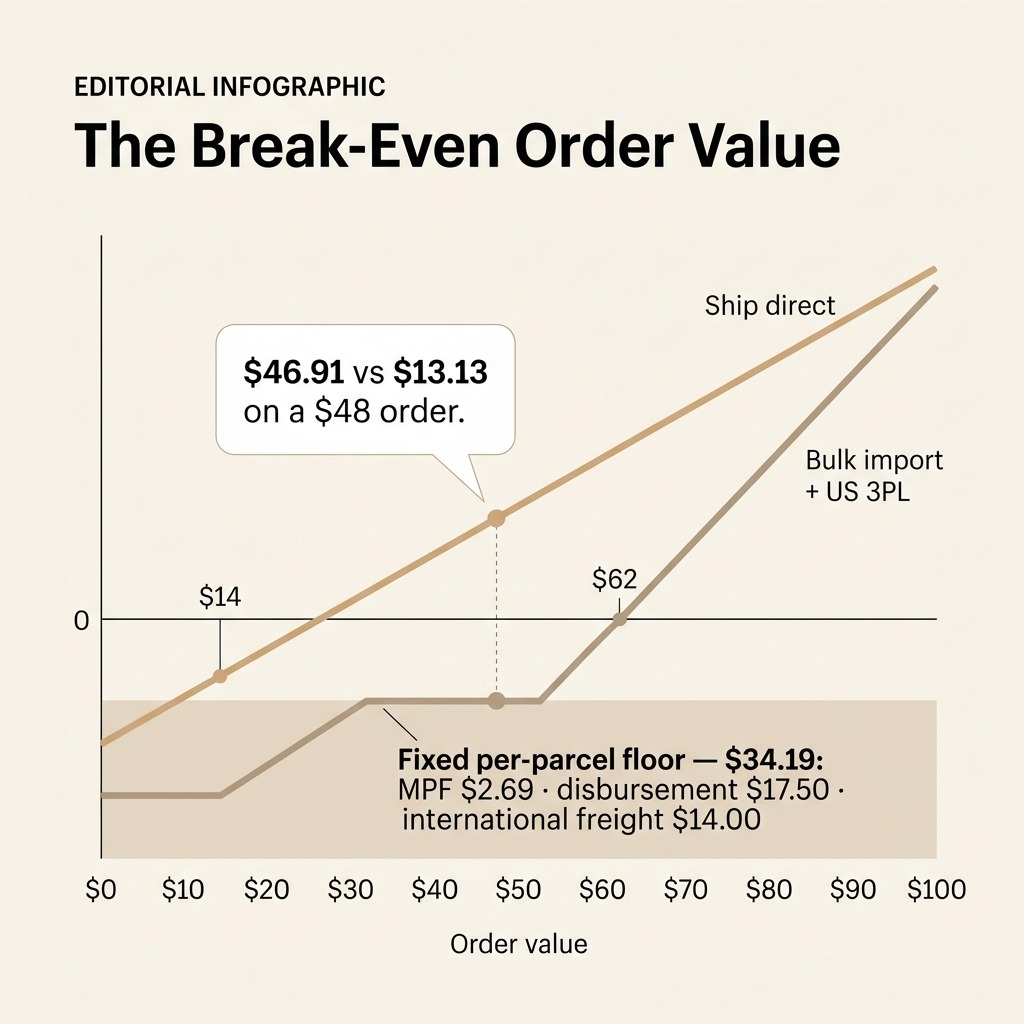
The reason Route A hurts so much on a $48 order isn't the tariff. It's the floor. $34.19 of that parcel — MPF, disbursement fee and international freight — is fixed. It does not care whether the box holds a $20 tee or a $200 coat.
Run both routes as a formula against order value, holding our tee's cost ratio (FOB at roughly 19% of retail), and you get two crossing points. Ship-direct turns contribution-positive at about a $62 order. Bulk-import into a US 3PL crosses at about $14.
Both figures sit before marketing and payment processing, so your real break-even is higher than either. The ranking doesn't move, though — and that spread is the number to take into your next planning meeting, not the headline tariff rate.
The three costs that refuse to scale down
- • MPF on an informal entry — a flat $2.69, charged per parcel, not per dollar.
- • Carrier disbursement — $17.50 minimum, whatever the duty was.
- • International parcel freight — roughly $14 for 500 g, and the cheap postal lane largely isn't there anymore.
Returns are where the duty dies

Apparel returns run near 25% of outbound orders. That rate was survivable when the parcel carried no duty. It isn't now.
On a direct parcel, the $12.72 of duty and $17.50 of disbursement die with the return. The unit is 8,000 miles from your warehouse, drawback on a single parcel costs more to file than it recovers, and the money is simply gone. You paid the customs bill on four units to keep three.
On a bulk import, duty was paid once at the dock and it stays with the good. A returned unit goes back on the 3PL shelf and resells at full price, carrying its $2.39 of duty with it. Duty on a parcel is a cost per transaction; duty on inventory is a cost per unit — and units get second chances.
Who should still ship direct
The math above is not an instruction to bulk-import everything. There are three cases where shipping direct still wins, and one of them is probably yours.
High average order value. That fixed $34.19 is 71% of a $48 order and 14% of a $250 one. Outerwear, tailoring, occasion pieces — direct shipping stays comfortably positive, and the duty premium on retail-value costing is one you can price for.
Genuinely unforecastable SKUs. Made-to-order, personalised, deep size-and-fit variance — anything where a bulk buy is a guess dressed as a plan. Duty is expensive; dead stock is worse.
Pre-launch and low volume. Our 3,000-unit buy is roughly $36,000 of cash on the floor before the first sale — product, duty, freight, brokerage and receiving. At 60 orders a month that's a four-year buy, and nobody should finance four years of inventory to save $33 an order. If that's where you are, the low-minimum, no-warehouse route is still the right one.
Which is why the answer most brands land on is a split, not a switch: pre-import the styles you can forecast, ship the rest direct until they earn a forecast of their own.
What we'd do in your shoes

We'd pull the last 90 days of orders, sort by SKU, and take the top decile — the handful of styles that make 60 to 70% of units. Those get costed as a bulk import: duty on FOB, one entry, one 3PL, and a first buy sized to eight or ten weeks of demand rather than a year of it. Everything else keeps shipping direct until its sell-through earns a forecast.
And we'd re-run the duty line against the rate on the day the goods clear, not the rate you costed at in spring — the mistake that broke a lot of August cost sheets. So: what does your top-selling SKU actually cost to deliver today — and have you run that number since the postal lane closed?
The bottom line
Six months of real data say the same thing the volume charts do. The end of de minimis didn't just add a tariff — it changed what the tariff is charged on, and it bolted a fixed toll onto every box crossing the border. Duty on the retail price plus $34.19 of unavoidable per-parcel cost is a different business model from duty on the factory price spread across three thousand units.
For most US clothing brands that means a split book: forecastable styles pre-imported and fulfilled domestically, the long tail shipped direct, and a break-even number you can actually name for each. The brands that got hurt this year weren't the ones on the wrong route. They were the ones who never re-ran the arithmetic after August.
October 22 is the next date on the calendar, when the new postal informal-entry process reaches its compliance deadline. That's the window to have your two columns costed — before peak, not during it.
FAQs
Is the $800 de minimis exemption coming back in 2026?
Nothing in the current record points that way. What began as an executive-order suspension in August 2025 became regulation on June 24, 2026, when CBP issued interim final rules suspending the exemption indefinitely for postal and non-postal shipments alike. Plan against the rule as written.
What does one parcel actually cost to import now?
For a $48 cotton tee shipped direct from India: $12.72 duty at 26.5%, $2.69 merchandise processing fee, a $17.50 carrier disbursement fee and about $14.00 of international freight — $46.91 in total. Your figures will move with origin, fibre, weight and carrier contract, but the shape of the stack is the same.
Why is duty higher on a direct-to-consumer parcel than on bulk inventory?
Because duty is charged on transaction value — the price paid for the goods sold for export to the US. On a direct parcel that transaction is the retail sale, so the base is what your customer paid. On a bulk import it's what you paid the factory. Same rate, very different base.
What is the merchandise processing fee on a low-value parcel in 2026?
An automated informal entry carries a flat MPF of $2.69 in fiscal 2026. Formal entries are charged 0.3464% of customs value with a $33.58 minimum and a $651.50 maximum — which is why spreading one formal entry across thousands of units costs pennies apiece.
At what order value does shipping direct still make sense?
On the cost ratios in this article, direct shipping turns contribution-positive at roughly a $62 order, against about $14 for bulk-import plus a US 3PL. Both sit before marketing and payment fees. High-AOV categories and genuinely unforecastable SKUs are where direct still earns its place.
What changes on October 22, 2026?
That's the compliance date for CBP's new postal informal-entry process for goods valued at $2,500 or less — the bonding and data-reporting requirements that come with it. The rule itself took effect on July 24; October 22 is when the postal-specific obligations bite.
How much inventory do I need to buy for bulk import to be worth it?
It's a cash question more than a unit-count one. The per-order saving is there from the first unit, but a 3,000-piece buy of a $9 tee ties up roughly $36,000 landed before the first sale. Size the first buy to eight to ten weeks of proven demand on your top-selling styles rather than a full year of a full range.
Does the duty rate depend on where I manufacture?
Yes, and it changed again in July. The Section 122 flat blanket expired on July 23, 2026 and was replaced the next day by Section 301 forced-labor tariffs at 10% for India, Bangladesh, Cambodia, Indonesia, Pakistan and a dozen others, and 12.5% for the remaining investigated economies. That sits on top of the MFN rate for your fibre and construction.
Read next
8 min read
Every Parcel Pays Now: The End of the $800 Rule
The rule change this mid-year check measures against.
9 min read
After the Cliff: Rebuild Your Cost Sheet for August
Duty follows the clearance date — how to re-cost for it.
7 min read
Prime Day's Over. Your Margin Report Isn't.
The other half of the margin story: fees, refunds, discounts.
Comments
No comments yet
Be the first to share your thoughts!