In our experience, most clothing brands don't fail because of bad design. They fail because they never learned how manufacturing works.
The designs are usually fine. What sinks a first collection is a spec that was never written down, a fabric chosen off a feel rather than a number, a sample signed off from a photo, and a retail price set against a factory quote that was never the real cost.
The US apparel market will turn over roughly $373 billion in 2026 (Statista), and about one in five new US businesses closes inside its first year, with only around half still trading at year five (Bureau of Labor Statistics).
Both numbers are true at once, and the distance between them is mostly sequence. Below is the build order that gets a first collection made and sold — eight steps, each one ending in a specific document, number, or filing you can point at before you spend money on the next.
What the first year of a clothing brand actually costs you
The honest answer: it costs time before it costs money, and then it costs money in a lump. Nine to twelve months from first sketch to first shipment is a normal, well-run timeline — not a slow one.
Three costs surprise first-time founders every single time. The first is sampling (the paid rounds of prototypes before bulk production), which almost always takes more rounds than planned. The second is landed cost (the true per-unit cost once freight, duty, and fees are added), which is not the number on the factory quote.
The third is returns. Retailers forecast a 15.8% overall return rate and 19.3% on online sales (NRF & Happy Returns), and apparel sits at the high end of that range because fit is the hardest thing to judge from a product page. Every point of return rate comes straight out of the margin you costed in Step 6.
“A first collection is not a creative project with a budget attached. It's a costing exercise with a creative brief attached.”
None of that is a reason not to start. It is a reason to start in order — and the failure patterns are consistent enough that we mapped them separately in the four operational mistakes behind most US clothing-brand failures.
What this looks like in practice
Eight months from first conversation to a launched brand
Badria Al Shihhi came in with a background in chemical engineering and public leadership — not fashion — and wanted a namesake label. The blocker wasn't taste. It was that traditional factories wouldn't take on a small first order with that much style variety.
Design, fabric sourcing, sample construction and a controlled first production run took eight months end to end, finishing with a fashion-show debut for the first collection. That is what the 9–12 month range in this guide looks like when the sequence holds and nothing has to be redone.
Read the full case studyStep 1 — Pick a niche you can say in one sentence
A workable niche names a specific customer, a specific problem, and a specific product category. “Elevated basics for everyone” is not a niche. “Heavyweight cotton tees cut for men over 6'2" who can't find length” is.
The test is repeatability. If a customer can describe your brand accurately to a friend in one sentence, your positioning works and your marketing gets cheaper. If they can't, you will pay for every single customer, forever.
Narrow also fixes a production problem. A tight niche means fewer styles, fewer fabrics, and fewer size curves — which means lower minimums, faster sampling, and a cost sheet you can actually understand.
“A niche you can say in one sentence is a niche a customer can repeat to a friend. Everything else is a mood board.”
Step 1 is done when you have
- • One sentence naming the customer, the problem, and the category.
- • Three named competitors and the specific reason a buyer picks you over each.
- • A price band you believe that customer will pay, written down.
Step 2 — Build a range plan, not a mood board
A range plan (the list of styles, colourways, and sizes you will actually produce) is the first document with money attached. It converts a Pinterest board into a number of units.
Keep the first drop to three to five styles. Every extra style multiplies through fabric minimums, sampling rounds, grading, photography, and inventory risk — and it is the fastest way to turn a launch budget into a warehouse.
Then decide the manufacturing route, because it changes everything downstream. Private label versus custom manufacturing is the real fork, and beginners are rarely shown the trade-off side by side:
| Private label | Custom development | |
|---|---|---|
| What you get | Your branding on an existing garment block | A pattern developed for your fit, owned by you |
| Time to market | Fastest — the block already exists | Longer — pattern, grading, more sample rounds |
| Upfront cost | Lower — no development to fund | Higher — you pay for the development |
| Fit as a differentiator | Limited — the block is what it is | This is the whole point |
| Copyable by a rival | Easily — same block is available to them | Much harder |
| Best when | Testing demand, or the product isn't the differentiator | Fit or construction is the reason to buy |
Step 2 is done when you have
- • 3–5 styles, each with colourways, a size run, and a target retail price.
- • A total unit count for the first run — the number every quote will hang off.
- • A decision, in writing, between private label and custom development.
Step 3 — Register the entity and clear the name before you print it
Form the business entity, get an EIN, open a business bank account, and register for sales tax where you have nexus. That part is administrative. The part that ends brands is the name.
Search the USPTO register before you buy the domain, and file early. Since the January 2025 fee restructure, a US trademark application costs a $350 base fee per class, with surcharges that stack — $100 per class for insufficient information and $200 per class for writing your own free-form description instead of using the ID Manual (Federal Register; USPTO fee schedule).
Apparel is Class 25. Filing before your first labels are woven costs a few hundred dollars; discovering a conflict after 500 garments carry the name costs the run.
Step 3 is done when you have
- • A registered entity, an EIN, and a business bank account.
- • A clean USPTO knock-out search on the name in Class 25.
- • An application filed — or a conscious, documented decision to wait.
Free download
The First-Year Clothing Brand Checklist
All eight steps as a printable checklist, with the document each one has to produce, a blank landed-cost worksheet, and the labelling fields US law requires. PDF.
Step 4 — The tech pack is the contract
A tech pack (the technical specification a factory manufactures from) carries the flat sketch, the graded measurement chart, the fabric and trim specification, stitch types, seam allowances, label placement, and packing instructions. It is the difference between ordering a garment and describing one.
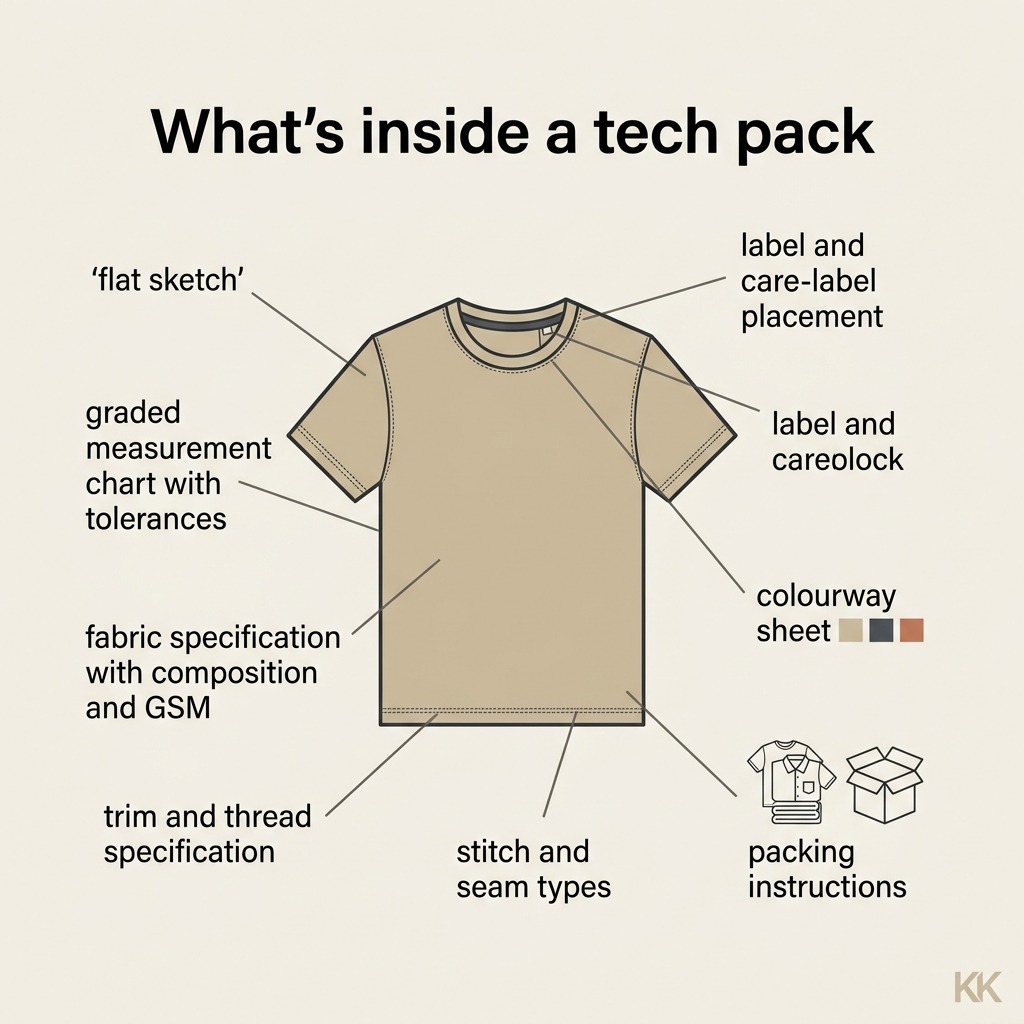
| Tech pack section | What goes wrong if you leave it out |
|---|---|
| Flat sketch | The factory interprets proportion from a photo |
| Graded measurement chart + tolerances | Sizes drift; returns cluster in one size |
| Fabric spec (composition, GSM, finish) | A lighter, cheaper cloth is substituted |
| Trim + thread spec | Zips and thread come in at the cheapest grade |
| Stitch + seam types | Seams fail at wear points after a few washes |
| Label + care-label placement | Relabelling by hand after the run lands |
| Packing instructions | Goods arrive creased, unfolded, or mis-cartoned |
Send a sketch and a reference photo, and the factory will fill every gap with the cheapest reasonable option — different thread, different interlining, a hem that reads wrong. That is not sabotage. It is what an unspecified field means.
A tech pack is also the only way to compare quotes honestly. Two factories quoting from the same spec are quoting the same garment; two factories quoting from a photo are quoting two different products. We broke the document down field by field in what a tech pack is and why you can't manufacture without one.
“Everything you don't write down, someone else decides for you — usually the cheapest way.”
Step 4 is done when you have
- • A tech pack per style, with a graded size chart and tolerances.
- • Named fabric and trims — composition, weight in GSM, and finish.
- • Label, care-label, and packing specifications included, not deferred.
Step 5 — Choose fabric by spec, then sample until the fit is boring
Fabric is chosen on four specifications, not on how a swatch feels in a showroom: composition, GSM (grams per square metre — the weight of the cloth), construction, and finish. Those four decide drape, durability, shrinkage, and roughly half your cost sheet.
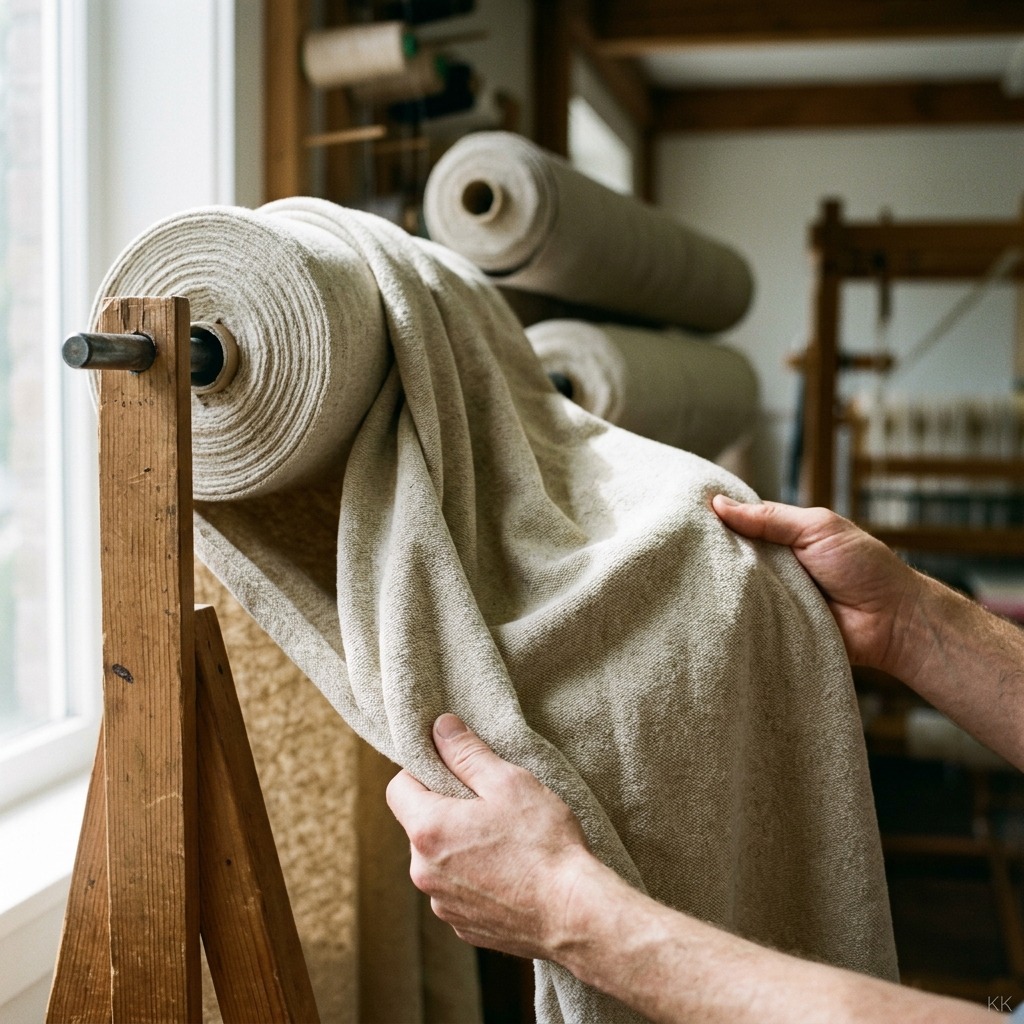
Judge cloth the way a buyer does — off the roll, against the light, at the weight you'll actually produce in. A square of fabric on a table tells you almost nothing about drape.
| Spec | What it means | What it decides |
|---|---|---|
| Composition | The fibre blend, e.g. 100% cotton | Feel, breathability, care label, duty code |
| GSM | Grams per square metre | Weight, opacity, perceived quality |
| Construction | Knit or woven, and the structure | Stretch, drape, how it must be sewn |
| Finish | Treatment after the cloth is made | Shrinkage, hand-feel, colour retention |
Ask for a wash test before you commit. A jersey that loses 6% in length after three washes will generate returns that no photography fixes — and the return, not the garment, is what your customer remembers. Our fabric sourcing guide walks the selection criteria in detail.
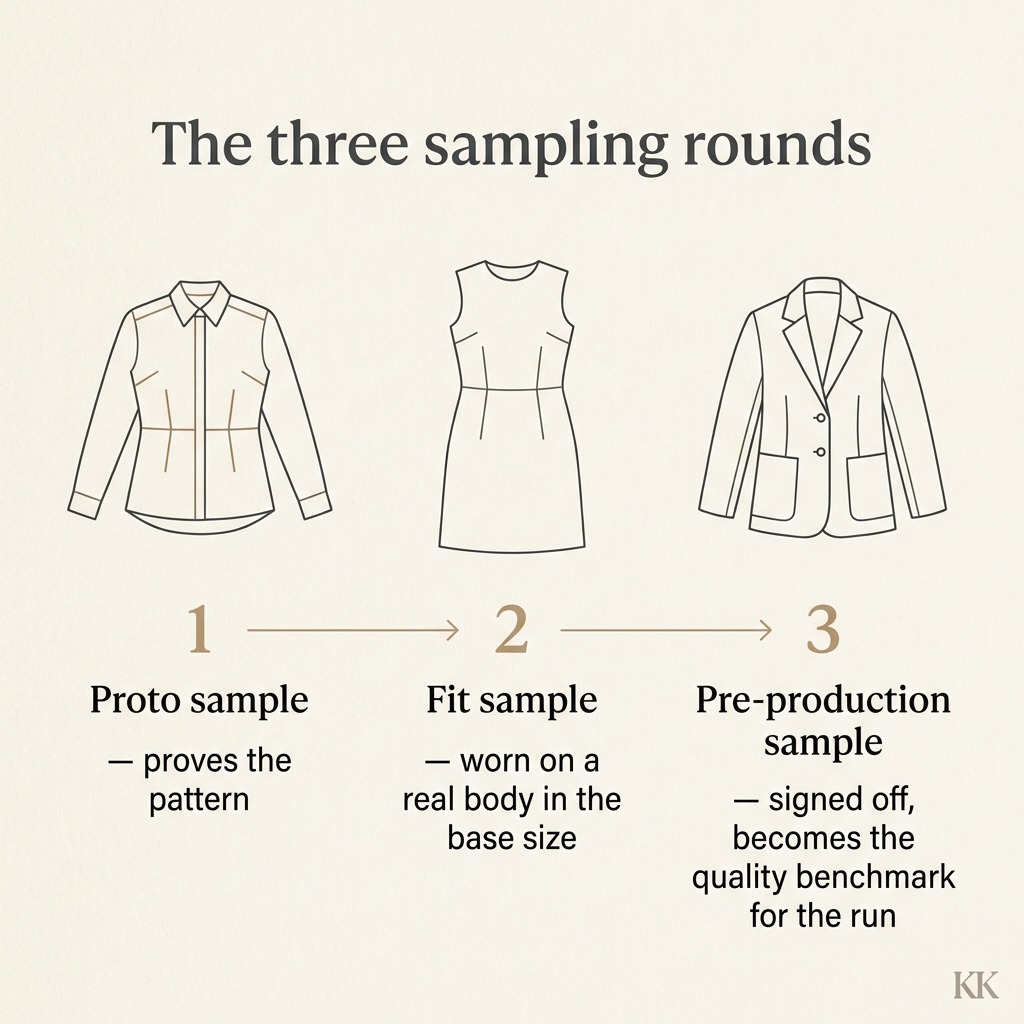
Then sample. Expect two to three rounds: a proto for the pattern, a fit sample on a real body in your base size, and a pre-production sample that is signed off and becomes the quality benchmark for the whole run. Approve nothing on a photo.
A mistake we see constantly at this stage
The sample was beautiful. The bulk run wasn't the same garment.
It is the most common failure in a first production run, and it has a name in every one of our project debriefs: sample quality that doesn't carry through to bulk. A sample is sewn slowly, by one skilled person, often on cloth from a different roll. Bulk is sewn fast, by a line, on the cloth you actually bought.
The fix is procedural, not creative. Supervise the sample run rather than receiving it in the post. Do fit approvals on real bodies and test movement, not just measurements. Send trial garments out for a wear test before you commit — on Drover that meant wear-testing trial shirts; on HY Official's SS24 Camp Shirt it meant repeated sample iterations on fit, fall and finish before anything went to bulk.
The cheapest round of sampling is always the one you do before the bulk order, not after it.
Step 5 is done when you have
- • A signed-off pre-production sample per style, physically in your hands.
- • Wash-test and shrinkage results on the actual production fabric.
- • A graded fit checked on a real fit model, not a mannequin alone.
Step 6 — Cost the landed price, not the factory quote
This is the step that separates brands that survive from brands that are quietly unprofitable at full price. The factory quote is an input. Landed cost is the number you price from.
2026 made this unavoidable. CBP indefinitely suspended the $800 de-minimis exemption on 24 June 2026, so low-value shipments now require formal or informal entry and carry duty, taxes, and fees (Federal Register). The “ship it direct and skip the paperwork” model that a lot of launch advice still assumes is gone.
Here is a 500-unit run of cotton tees, classified under HTS 6109.10.00, which carries a 16.5% general duty rate (USITC Harmonized Tariff Schedule):
| Cost line | Per unit (500-unit run) |
|---|---|
| Factory price (FOB) | $12.00 |
| Ocean freight + insurance | $0.85 |
| US duty @ 16.5% | $1.98 |
| Customs fees + broker | $0.30 |
| Inbound to 3PL + inspection | $0.45 |
| Landed cost | $15.58 |
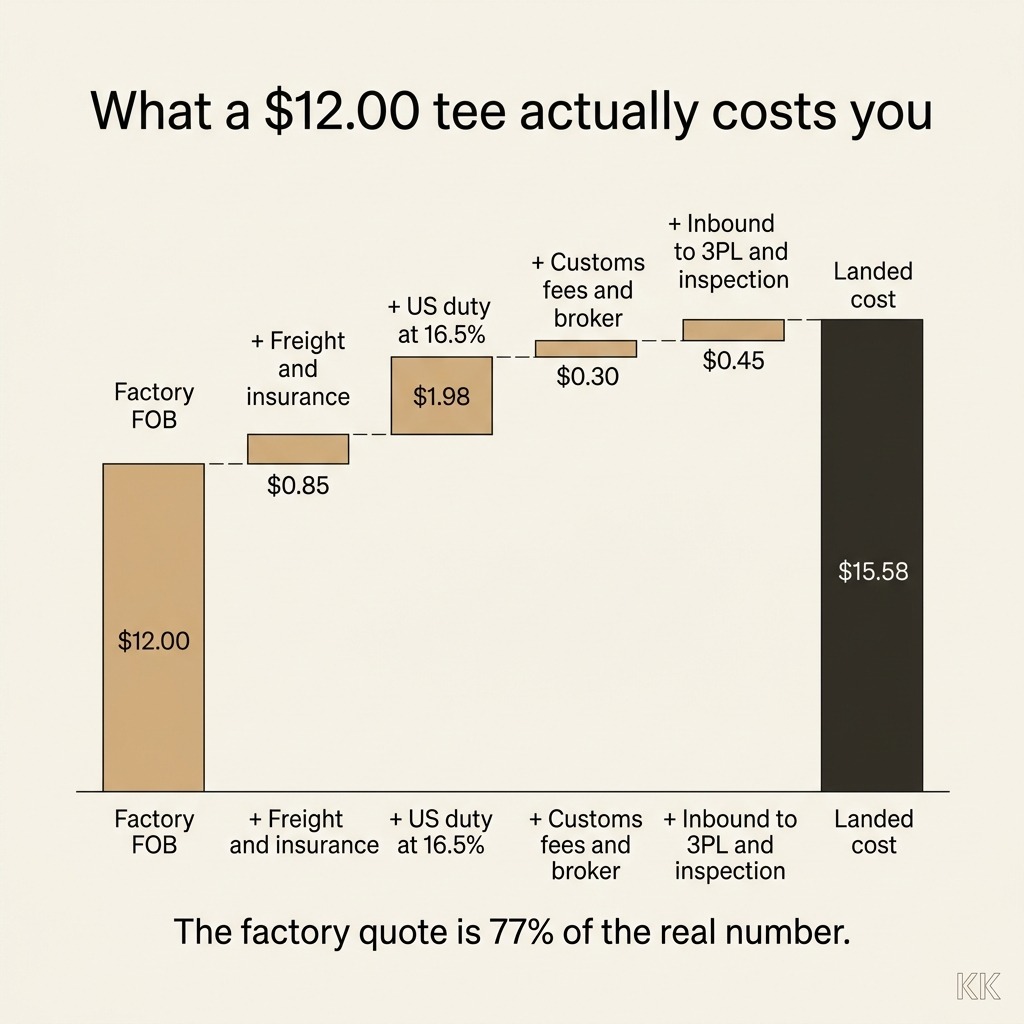
The factory quote is 77% of the real cost. A founder who prices at 4× the quote thinks they have built a $48 tee at a healthy margin; they have actually built a $48 tee on a $15.58 cost, before returns, shipping, payment fees, and acquisition. Price off the wrong number and the gap never shows up until the third month of settlements.
Treat those figures as a worked structure, not a quote. Duty depends on the exact classification, the country of origin, and whatever trade actions are live when your goods clear — get the HTS code confirmed for your specific garment before you commit to a retail price. Lead times move too, which is why the design-to-doorstep timeline belongs in the same spreadsheet.
“The factory quote is about three-quarters of what the garment actually costs you. Price off the quote and you've already given the margin away.”
Step 7 — Labels are federal law, not decoration
Every garment you sell in the US needs three things on a permanent label: fibre content, country of origin, and the identity of the manufacturer or the business responsible — either a company name or a registered identification number (FTC, Threading Your Way Through the Labeling Requirements).
A fourth requirement comes from a separate rule. The FTC's Care Labeling Rule requires permanent care instructions on textile wearing apparel, and the brand must have a reasonable basis for the instruction it prints (16 CFR Part 423).
Put all four in the tech pack in Step 4. Adding them after the run means relabelling every unit by hand, and that cost lands the week you were meant to launch.
Step 7 is done when you have
- • Fibre content, country of origin, and responsible-party ID on a permanent label.
- • Care instructions you can substantiate, on a permanent care label.
- • All of it specified in the tech pack — approved on the pre-production sample.
Step 8 — Launch small, sell through, then scale
Order the smallest run your economics tolerate. Unsold inventory is the most expensive mistake in apparel because it consumes the cash you need for the reorder of the thing that did sell.
Then measure two numbers before designing anything new: sell-through rate (the percentage of a run sold in a set window) and return rate by size. Sell-through tells you whether the product works; returns by size tell you whether the grading does.
The counterexample — when to break this sequence. If you already have an audience, run it backwards: take pre-orders or run a small made-to-order drop from the sampling stage, and let real demand size the first production run. Founders with distribution should validate before they invest in tooling; founders without distribution should build the product first. Choose based on which one you actually have, not on which is more comfortable.
“Sell through the first run before you design the second. That one rule prevents most inventory graveyards.”
Signs you're scaling too early
- • You're designing drop two while drop one is under 60% sold through.
- • Your best-selling size is out of stock and the reorder isn't funded.
- • Return rate is above your baseline and you haven't traced it to a size.
- • You added styles before you re-costed the ones you already make.
The 12-month build order, in one view
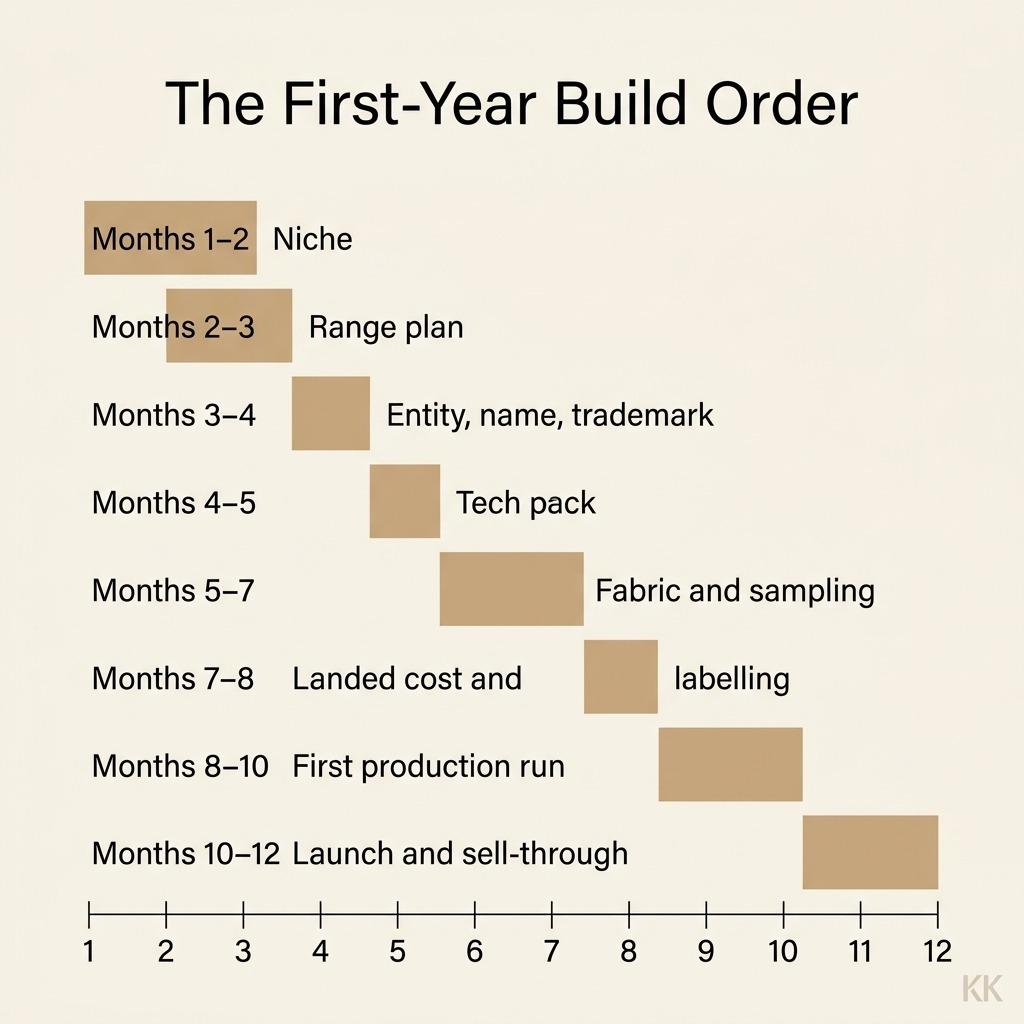
| Months | Step | What it has to produce |
|---|---|---|
| 1–2 | Niche | One-sentence positioning + price band |
| 2–3 | Range plan | 3–5 styles and a total unit count |
| 3–4 | Entity, name, trademark | EIN + Class 25 filing |
| 4–5 | Tech pack | Graded spec per style |
| 5–7 | Fabric & sampling | Signed pre-production sample |
| 7–8 | Landed cost & labelling | Cost sheet + compliant label set |
| 8–10 | First production run | Goods cleared and at the 3PL |
| 10–12 | Launch | Sell-through and return-rate read |
Bands overlap in practice — sampling runs while the trademark sits in examination, and photography is booked while goods are on the water. What does not overlap is the dependency chain: no fabric decision without a tech pack, no cost sheet without a fabric decision, no retail price without a cost sheet.
The terms you'll hear, in plain English
Most of the confusion in a first manufacturing conversation is vocabulary, not concepts. These are the words that will come at you, and what each one actually means.
- Tech pack
- The technical specification a factory manufactures from — sketches, measurements, fabric, trims, stitches, labels, packing. Your contract with the maker.
- GSM
- Grams per square metre: how heavy the cloth is. A 180 GSM tee is light and summery; 240 GSM reads premium and structured.
- MOQ
- Minimum order quantity — the smallest run a factory or mill will accept, usually set per style, per colour, and per fabric.
- FOB
- Free on board: the price of the goods loaded at the origin port. It excludes freight, duty and every fee after that point.
- Landed cost
- What a unit truly costs once freight, duty, customs fees, brokerage and inbound logistics are added. The number you price from.
- HTS code
- The Harmonized Tariff Schedule classification that sets your US duty rate. Cotton knit tees sit at 6109.10.00.
- Grading
- Scaling an approved base-size pattern up and down into a full size run while holding the fit relationships.
- Proto / fit / PP sample
- The three sampling rounds: proto proves the pattern, fit sample is worn on a real body, pre-production sample is signed off as the quality benchmark.
- Colourway
- One colour version of a style. Each colourway is a separate production line item and its own inventory risk.
- Sell-through rate
- The percentage of a production run sold within a set window. The number that tells you whether to reorder or stop.
- Lead time
- Elapsed time from placing the bulk order to goods arriving. Fabric availability, not sewing, is usually the long pole.
- 3PL
- Third-party logistics: the warehouse that stores your inventory and ships orders to customers on your behalf.
The bottom line
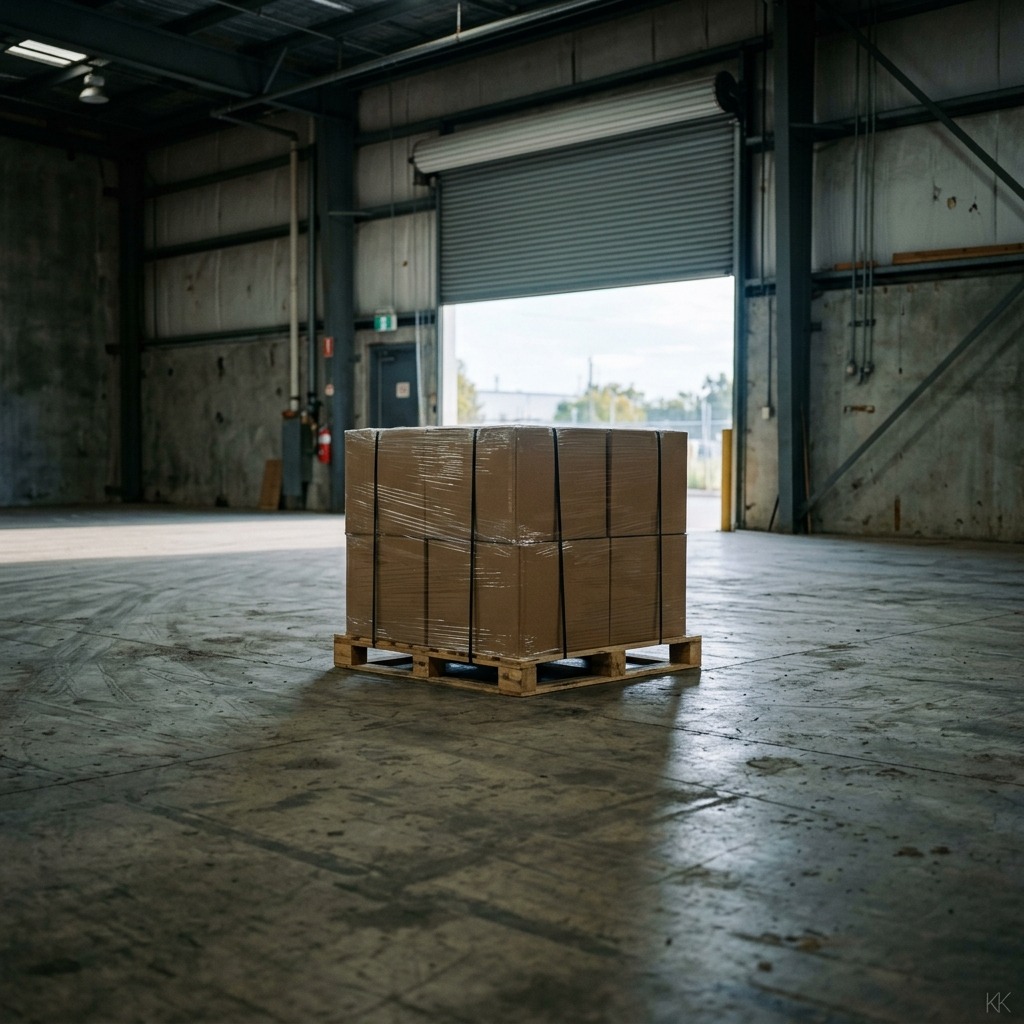
Starting a clothing brand in 2026 is not a creativity problem. It is a sequencing problem: the founders who get to a second run are the ones who refused to move to the next step until the current one produced a document they could point at.
If we were in your shoes, we'd spend this week on Steps 1 and 6 — the sentence and the cost sheet — because those two decide whether everything in between is worth building. So: can you say your niche in one sentence, and do you know your landed cost per unit? If either answer is no, that is where the next month goes.
FAQs
Why do most new clothing brands fail?
In our experience it is rarely the design. It is manufacturing literacy — a specification that was never written down, fabric chosen by feel instead of by composition and GSM, a sample approved from a photograph, and a retail price set against a factory quote rather than a landed cost. Each of those is a process failure, and each one is preventable by working in sequence.
How do you start a clothing brand in 2026?
In this order: define a one-sentence niche, build a range plan of three to five styles, register the entity and clear the name with the USPTO, write a tech pack per style, select fabric by specification and sample until fit is signed off, calculate landed cost rather than the factory quote, apply US labelling requirements, then produce a small first run and measure sell-through before scaling.
How long does it take to launch a clothing brand?
Nine to twelve months from first sketch to first shipment is a realistic, well-run timeline. Fabric sourcing and two to three sampling rounds usually take the longest, and bulk production plus ocean freight and customs clearance typically adds another two to three months on top.
What is landed cost, and why does it matter more in 2026?
Landed cost is the true per-unit cost after freight, duty, customs fees, brokerage, and inbound logistics. It matters more now because CBP indefinitely suspended the $800 de-minimis exemption on 24 June 2026 (Federal Register), so low-value shipments now carry duty and entry requirements. On a worked 500-unit tee example, the factory quote was 77% of the landed cost.
What has to be on a clothing label sold in the US?
Fibre content, country of origin, and the identity of the manufacturer or responsible business — plus permanent care instructions under the FTC's Care Labeling Rule (FTC). Specify all four in the tech pack so they are made into the garment rather than added afterwards.
Do I need a trademark before I launch a clothing brand?
You are not legally required to register one, but apparel is a crowded register and rebranding after production is expensive. A US application costs a $350 base fee per class, with surcharges of $100 per class for insufficient information and $200 per class for a free-form description (Federal Register). Clothing is Class 25.
How many styles should be in a first collection?
Three to five. Every additional style multiplies through fabric minimums, sampling rounds, grading, photography, and inventory risk — and a narrow first drop keeps the cost sheet legible enough to actually price from.
Should a first-time founder use private label or custom manufacturing?
Private label puts your branding on an existing garment block and gets you to market faster with less development cost. Custom manufacturing builds a pattern that belongs to you and supports a real fit advantage, but takes longer and costs more upfront. The full comparison is here.
What return rate should a new clothing brand plan for?
Plan conservatively. Retailers forecast a 15.8% overall return rate and 19.3% on online sales (NRF & Happy Returns), and apparel sits at the upper end because fit is hard to judge online. Build the assumption into your cost sheet before you set retail price.
Read next
What Is a Tech Pack? (And Why You Can't Manufacture Without One)
Step 4 in full — every field a factory needs, and what happens to the ones you leave blank.
Read the breakdownTalk to us
Get your first collection through Steps 4 to 8
Talk to a Krazy Kreators production lead about starting your clothing brand — tech packs, fabric sourcing, sampling, and a costed first run under one roof.
Read next
8 min read
Zero MOQ, No Warehouse, No Factory Contract
The lower-risk route to a first drop when cash is the constraint.
8 min read
The Real Cost of the Wrong Clothing Manufacturer
Wrong samples, defective bulk, no one to call — where a first run dies.
9 min read
Why Most US Clothing Brands Fail in 5 Years
The four operational mistakes behind the failure rate.
About Krazy Kreators
Krazy Kreators is the end-to-end brand-building partner for US clothing founders — design, sampling, fabric sourcing, retail-grade production, and packaging, under one roof, from first sketch to shelf. krazykreators.com
Comments
No comments yet
Be the first to share your thoughts!