Sourcing clothing manufacturing from India got materially cheaper for US brands on 24 July, and almost nobody has re-run their numbers since.
Look up the trade data and you will think the opposite is happening. It shows India losing US orders all year, heavily. That data is a rear-view mirror, and what it is reflecting ended five weeks ago.
Here is what actually changed on that date, what it conspicuously did not change, and why the gap between the published figures and the current rate is the whole opportunity.
India spent this year losing US orders
Start with the awkward part. Over January to May, US apparel imports from India fell 26.4%, while the total US apparel import market fell 9.3% — on OTEXA figures reported in July. India did not hold its share. It lost roughly three times more than the market did.
Meanwhile the China volume everyone talks about did move. Shipments from China dropped 42.8% to $2.80 billion over the same five months. Cambodia took 14.9% more, Indonesia 5.5% more, and Vietnam held the top spot at $6.39 billion.
So the diversification is real, and it has been running for two years — we mapped where it was going in the US plus-one sourcing playbook. India simply was not the destination.
Here is the part that gets missed, though. India’s apparel exports did not shrink — they were redirected. Ready-made garment exports grew 2.9% across the financial year to March 2026, and shipments to the EU hit a record $4.66 billion.
The US remains India’s largest apparel customer at $5,330 million, or 33.37% of the book. But the EU is now within striking distance of it, which tells you those factories found other work.
“The capacity did not disappear while America was not buying. It went to Rotterdam and Felixstowe.”
That matters commercially. A factory that spent a year filling European orders is not a distressed supplier who will take anything, and it will not price like one.
What changed on July 24
The temporary Section 122 duties ran out of time. What replaced them, at 12:01 a.m. eastern on 24 July, was the final action in the USTR’s forced-labor Section 301 investigations covering 60 economies.
It sorts trading partners into two tiers. Economies that have adopted a forced-labor import prohibition, or committed to one, pay an extra 10%. Everyone else pays 12.5%.
India landed in the 10% tier. Vietnam, Turkey, Thailand, the Philippines and China did not — Greenberg Traurig’s breakdown lists both groups in full. We covered the proposal stage of this action back in July, when the tiers were still a proposal; several countries moved between the two before the final notice.
These duties stack. They sit on top of the MFN rate (most-favoured-nation — the standard duty a product carries by classification), and on top of any other trade remedy already in force. A cotton knit tee sits under HTS 6109.10.00 at 16.5%, so India’s tee pays 16.5 plus 10.
Infographic 01
One $14 tee, four origins, after July 24
Duty on a cotton knit tee at a $14 factory price. General rate of 16.5% plus the Section 301 tier the origin sits in. China also still carries its legacy 7.5% List 4A duty.
China is the outlier because it keeps its legacy List 4A duty as well. That is where the ten-point gap between India and China comes from — two separate actions, not one. The full origin-by-origin map of the new regime, including the three lanes that now pay nothing extra, is in what actually replaced Section 122.
The tariff made India level, not cheap
This is the sentence most coverage of the July action skipped. Bangladesh, Cambodia, Indonesia, Pakistan and Sri Lanka are all in the same 10% tier as India.
Which means a cotton tee from Dhaka and a cotton tee from Tiruppur now clear US customs at exactly the same 26.5%. Against China and Vietnam, India gained something real. Against the rest of Asia, it gained nothing at all.
So if you are choosing between India and Bangladesh, put the duty line away. It is identical, and every argument that decides the question is somewhere else: fabric, development, communication, how a sample round actually goes.
The counterexample worth knowing
Qualifying apparel from the DR-CAFTA countries and from Canada and Mexico under USMCA is exempt from these duties entirely. If your garment can meet those rules of origin — and yarn-forward rules are strict — nothing in Asia competes with zero. For most cotton-led programmes that route is closed on fabric availability, which is exactly why it is worth ten minutes of checking rather than an assumption.
What India has that the rest of the tier doesn’t
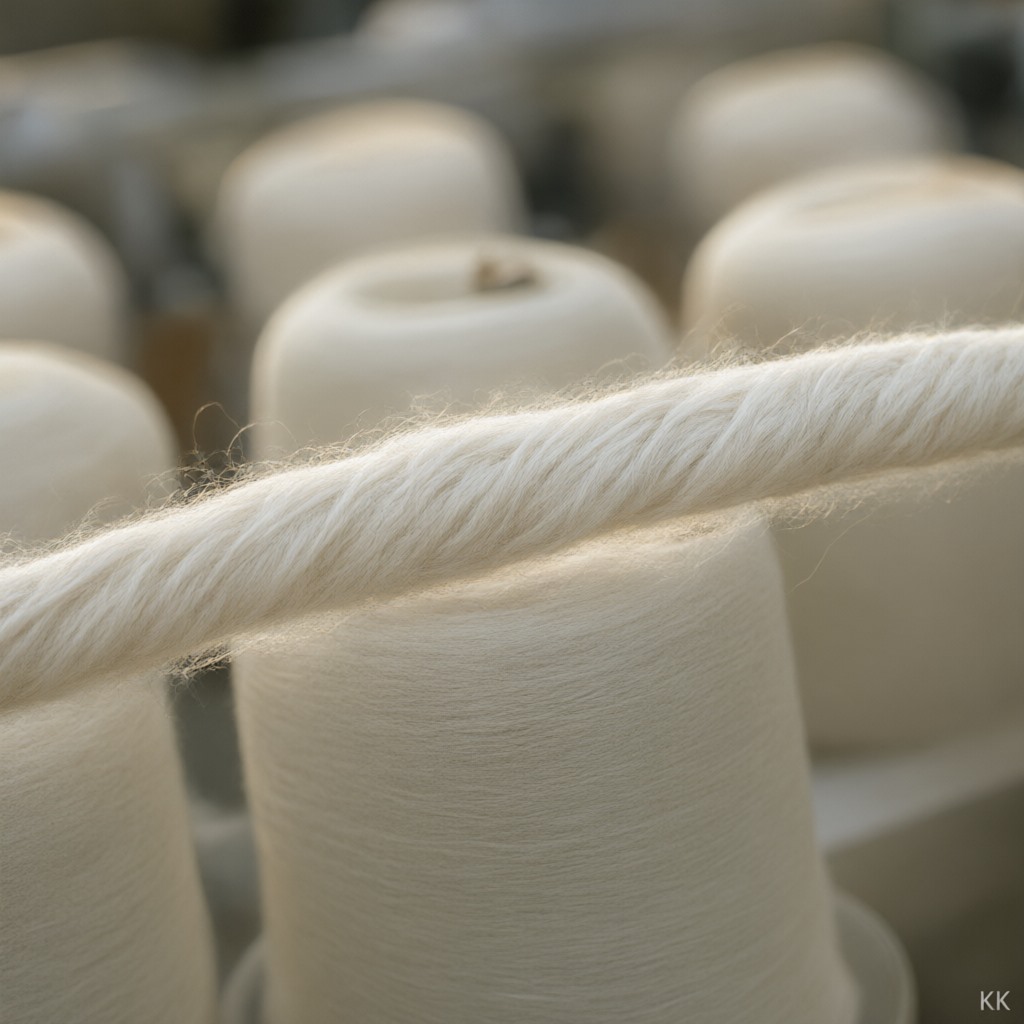
One structural thing, and it starts several steps before a sewing machine. India grows its own cotton — more of it than anyone — then spins, weaves, knits, dyes and cuts it without the cloth leaving the country. India Brand Equity Foundation puts the workforce across that chain at over 45 million.
Most competing origins import their fabric. That is the whole difference, and you feel it in two places.
Development gets faster. Changing a yarn count, a GSM or a shade means a conversation with a mill a few hours away, not a fabric order with its own lead time and its own customs entry. Short runs work for the same reason: the cloth already exists somewhere in the chain.
Craft capacity is unusual. Hand embroidery, hand-finishing and small-batch surface work sit inside the same supply base as volume production — which is why the premium end of the market went there first, as we argued in the “Made in India” shift in American luxury.
“Ask where the fabric comes from. In most origins that is a shipping question. In India it is a driving question.”
The cost sheet, both ways
Take a mid-weight cotton tee at a $14 factory price and run 5,000 of them. Duty is the only line changing here; freight, fees and brokerage land on all three origins.
Infographic 02
What the gap is worth on one order
The same 5,000-piece run, same $14 factory price, three origins. Duty only — freight, fees and brokerage sit on top of all three.
Read the second gap more carefully than the first. Seven thousand dollars against China is a genuine argument for moving. One thousand seven hundred and fifty against Vietnam is not — a single fit problem, a delayed shipment or a 2% defect rate erases it without noticing.
Duty is also the line you control least. A factory price two dollars lower, or a lead time three weeks shorter, moves more money than the entire tariff difference between the two 10%-tier countries you are agonising over. The full re-costing method is in a second origin, costed in 30 days.
Free download
The Origin Comparison Sheet
One page that costs the same style across four origins side by side — factory price, duty at the current tier, freight, fees and landed cost per unit — plus the eleven questions to send a supplier before you request a quote. Spreadsheet + PDF.
Where sourcing clothing manufacturing from India will cost you
Three things, and none of them are secret. Any Indian exporter will tell you the same if you ask directly.
Synthetics are the weak lane. India’s strength is cotton, but a large share of world apparel trade is man-made fibre — performance knits, technical outerwear, anything with stretch and recovery. Despite a ₹10,683 crore production-linked incentive scheme aimed squarely at that gap, garment-side capacity has not caught up. For a technical product, Vietnam’s 29% may still be the cheaper number.
Scale is not China’s scale. India’s entire ready-made garment export book runs to roughly $15.8 billion a year. Vietnam shipped $6.39 billion to the US alone in five months. If your programme needs 50,000 units of one style from one roof, the shortlist is short.
The incentives have expiry dates. Indian quotes are shaped by export support schemes, and those schemes keep moving. Rates under the RoDTEP remission scheme were cut by half against a reduced budget, while the garment-specific RoSCTL rebate and a raw-cotton duty exemption run only to 30 September and 31 October 2026 respectively.
So a quote you accept in September may be resting on a subsidy that lapses before your goods ship. Ask what the price looks like without it.
Signs you are comparing the wrong things
- • Your spreadsheet has a duty column but no lead-time column.
- • You are choosing between two countries in the same tariff tier on tariff grounds.
- • Nobody has told you which mill the fabric comes from.
- • The quote is valid for 90 days and the incentive behind it expires in 40.
- • You are pricing a synthetic garment against a cotton benchmark.
Vetting a partner before you move a style
Move one style, not a range. Pick the garment you understand best — the one whose fit problems you could describe from memory. A new origin should be tested against a known quantity, not a new design.
Ask about the mill, not just the factory. Who knits or weaves the cloth, where, and what is their run size. In India that answer is usually specific and nearby, and a supplier who cannot give it is buying on the open market — which is fine, but it changes your lead time and your shade consistency.
Send a real tech pack and budget two sample rounds. Most origin switches that go wrong go wrong here, not at the price stage — a point we have made at length in what a tech pack actually is. Judge the second sample, not the first; the first tells you about the pattern, the second tells you about the factory.
Get the paperwork right before the goods move. Country of origin, the HTS classification you believe applies, and the duty stack on it all belong in writing with the commercial invoice terms. The mechanics for first-time importers are in our checklist for exporting apparel from India.
Write a duty-adjustment clause. This regime is four weeks old and carries no expiry date, which is not the same as permanence. Any contract delivering more than a quarter out should say who absorbs a rate change, in a sentence, agreed in advance. Founders who had that clause in place on 24 July had a much better week than founders who did not — the background is in why US brands started moving production out of China.
What we’d do in your shoes
Cost one style in India properly this quarter, while the rest of the market is still reading trade data from the old regime and drawing the wrong conclusion from it. Do not move the whole range, and do not move anything at all on a 2.5-point duty gap.
Move because the fabric conversation gets shorter and the development cycle gets faster, and let the duty be the reason it now pencils. If you costed India in the spring and put it aside — is the number you rejected even the right number any more?
Common questions
What tariff do US brands pay on clothing made in India in 2026?
A cotton knit tee from India lands at 26.5% — the 16.5% general rate for that classification plus the 10% Section 301 forced-labor duty that took effect on 24 July 2026. The same garment from Vietnam pays 29%, and from China 36.5%, because China still carries a legacy Section 301 duty on top. Rates vary by product classification, so check the one your garment actually falls under rather than assuming the tee rate.
Is sourcing clothing manufacturing from India cheaper than China now?
On duty, yes — ten percentage points cheaper on a cotton tee, which is roughly $1.40 a unit on a $14 factory price. On the total landed number it depends on your product. China still holds a deeper man-made-fibre base and larger single-factory capacity, so for technical outerwear or a 50,000-unit programme the duty saving can be swallowed by price and lead time. For cotton-led product in the low thousands, India usually comes out ahead.
Does India have a tariff advantage over Bangladesh or Sri Lanka?
No. Bangladesh, Cambodia, Indonesia, Pakistan and Sri Lanka all sit in the same 10% tier as India, so a cotton tee from any of them clears at the same 26.5%. The July action removed India's penalty rather than granting it an edge. Anything that makes India the better choice over those origins is non-tariff — the domestic fibre-to-garment chain, short-run flexibility, and how a factory handles development.
Why did US apparel imports from India fall in 2026 if India is competitive?
Because for most of the year India was carrying a punitive US rate that its competitors were not. Shipments to the US fell 26.4% over January to May while the whole market fell 9.3%. India's global apparel exports still grew 2.9% in the same financial year — the goods went to the EU and the UK instead. The rate that caused the diversion ended on 24 July.
How should a small brand vet an India manufacturer?
Move one style, not a range. Ask which mill the fabric comes from rather than only about the factory, because the mill sets the real lead time and the real minimum. Budget two sample rounds before you talk price. Get the country of origin and the duty stack written into the commercial invoice terms, and put a duty-adjustment clause in any contract that delivers more than a quarter out.
About Krazy Kreators
Krazy Kreators is the end-to-end brand-building partner for US clothing founders — design, sampling, fabric sourcing and retail-grade production, and packaging, under one roof, from first sketch to shelf. Recent work is in the luxury wear portfolio. krazykreators.com
Read next
9 min read
The US Plus-One Sourcing Playbook
Why brands added an origin instead of replacing one — and where the money went.
8 min read
The “Made in India” Trend in American Luxury
The craft capacity that pulled the premium end of the market east first.
7 min read
Moving Manufacturing to India
The case beyond cost — capability, chain control and what changes day to day.
Comments
No comments yet
Be the first to share your thoughts!